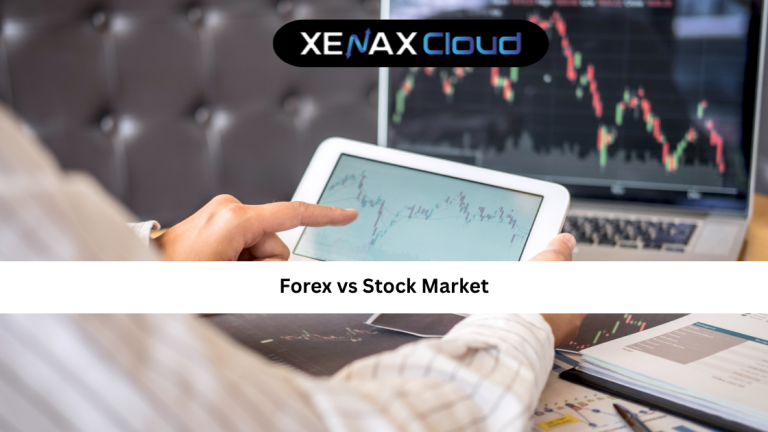
If you are entering financial markets, one of the first questions you will face is forex vs stock trading. Both markets offer profit opportunities, but they operate differently in structure, volatility, and strategy.
Choosing between them is not just about preference. It affects risk exposure, trading hours, leverage, and technology requirements.
In this detailed forex vs stock trading guide, we will explain the differences, performance factors, real-world use cases, and how infrastructure plays a role in trading success.

Understanding Forex vs Stock Trading Basics
To simplify the comparison, let’s define both markets clearly.
Forex trading involves buying and selling currency pairs like EUR/USD or GBP/JPY. The forex market is decentralized and operates 24 hours a day, five days a week.
Stock trading involves buying and selling shares of publicly listed companies such as technology, banking, or energy firms. Stock markets operate during specific exchange hours.
The main distinction in forex vs stock trading lies in liquidity and market structure.
Forex is the largest financial market in the world, with high liquidity and constant movement. Stocks are tied to company performance and exchange regulations.
Understanding these fundamentals helps traders choose wisely.
Forex vs Stock Trading Tutorial: Market Structure and Volatility
In this forex vs stock trading tutorial, we focus on volatility and execution.
Forex markets often show smaller price movements but allow leverage. This means traders can control larger positions with smaller capital. However, leverage increases risk.
Stock markets may experience larger price swings based on earnings reports or global events.
Liquidity also differs. Major forex pairs have high liquidity, allowing quick trade execution. Some small-cap stocks may have lower liquidity, causing slippage.
When evaluating forex vs stock trading, consider how quickly you want to enter and exit trades.
Real-World Use Cases: Who Chooses Forex and Who Chooses Stocks?
Understanding practical examples helps clarify forex vs stock trading decisions.
Day Traders
Forex is popular among day traders due to 24-hour availability and high liquidity.
Long-Term Investors
Stock trading suits investors focused on company growth and dividends.
Algorithmic Traders
Automated bots require VPS hosting for uninterrupted execution.
Portfolio Diversifiers
Some traders combine both markets for balanced exposure.
Each approach benefits from stable online infrastructure, especially when trades are executed through digital platforms.
Why Indian Servers Can Handle Global Trading Traffic Efficiently
Server location impacts trading speed.
Indian infrastructure connects strongly across Asia and the Middle East while remaining competitive globally.
Below is a general comparison overview.
| Region | Latency in Asia | Global Connectivity | Support Availability | Provisioning Speed |
|---|---|---|---|---|
| India | Very Low | Competitive Worldwide | 24/7 | Fast |
| USA | Moderate | Strong in Americas | Time Zone Dependent | Moderate |
| Canada | Moderate | Strong in North America | Business Hours Focused | Moderate |
| Germany | Higher for Asia | Strong in Europe | Business Hours Focused | Moderate |
| UAE | Good for Middle East | Regional Strength | Regional | Fast |
This demonstrates how Indian servers efficiently support global trading traffic while maintaining competitive speeds.
Scalability Options for Professional Traders and Agencies
As trading strategies evolve, infrastructure needs grow.
Professional traders managing multiple bots may require higher configurations such as:
- KVM VPS 4 — 16 Vcore CPU, 64GB RAM, 100GB Storage, 10TB Bandwidth — see current pricing
Agencies offering signal services or copy trading platforms need scalable environments.
Upgrading VPS resources ensures stability during high-volume trading sessions.
The latest offers and discounts are always available at:
https://xenaxcloud.com/shared-hosting/
Scalable hosting protects your trading strategy from technical interruptions.
Frequently Asked Questions
Xenax Cloud Shared Hosting vs the usual alternatives
| Feature | Xenax Cloud | Typical Indian shared host | Global budget host |
|---|---|---|---|
| Starting price | ₹149/mo | ₹199/mo | ₹149/mo (renews ₹499) |
| Storage | 15 GB SSD storage | 10 GB SSD | 25 GB SSD |
| DDoS protection | 100 Gbps, always on | Basic | Cloudflare only |
| Support | 24×7, in-house engineers | Tickets, business hours | Chat, outsourced |
| Data centre | India (NVMe) | India | Singapore / US |
| Control panel | cPanel / WHM included | cPanel | Custom panel |
Entry-level plans, list prices including GST where shown. Check each provider before buying — prices change.
See Shared Hosting plansWhat is the difference between Indian VPS and foreign VPS?
Can Indian servers handle global website traffic?
Is Indian hosting cost-effective for international users?
How reliable is XenaxCloud hosting?
How to choose the right server for my business?
Conclusion: Choose the Right Market and the Right Infrastructure
The debate of forex vs stock trading depends on your risk tolerance, trading style, and long-term goals.
Forex offers 24-hour liquidity and high leverage opportunities. Stocks provide company-based investment growth and dividends.
Regardless of your choice, reliable infrastructure is essential for secure and fast trade execution.
Indian hosting environments deliver cost-effectiveness, low latency in Asia, competitive global speeds, strong security compliance, and scalable VPS solutions.
XenaxCloud offers powerful VPS hosting backed by transparent pricing and a 15-day money-back guarantee.
If you want stable, secure infrastructure to support your trading journey, choose XenaxCloud and trade with confidence.