A growing online store can reach a point where shared hosting no longer gives enough control over the server environment. A dedicated server for ecommerce India gives the store an entire physical server instead of sharing server resources with other websites.
Xenax Cloud operates one data centre in Banda, Uttar Pradesh, India. Its dedicated servers are hosted there. For an ecommerce business serving customers from India, that means the hardware is physically in India. If your customers are primarily overseas, network distance should be considered before choosing the server location.
The important decision isn’t simply whether you need a dedicated server. You need to determine whether your store’s traffic, application stack, database workload and operational requirements justify dedicated physical resources.
When Does a Dedicated Server for Ecommerce India Make Sense?
A dedicated server becomes relevant when an ecommerce application needs resources that are difficult to guarantee on shared infrastructure.
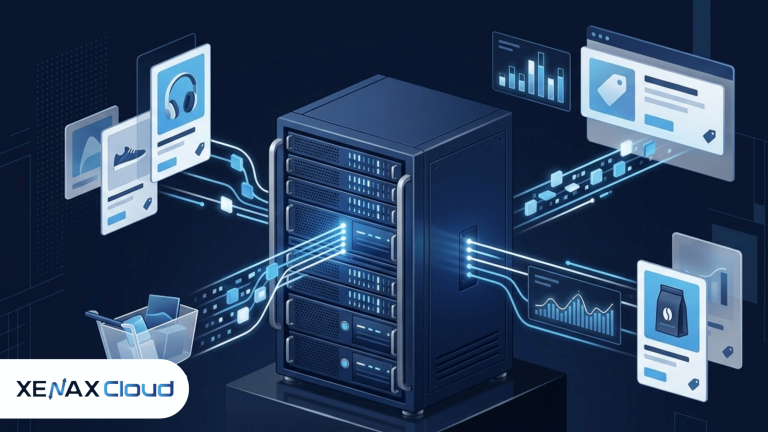
An online store typically has several components working together: the website or storefront, application code, product catalogue, database, payment integrations, search, customer accounts and administrative tools.
Traffic isn’t the only factor. A store with moderate traffic but a resource-heavy application can have different requirements from a simple catalogue website with more visitors.
Dedicated hosting gives the business the full physical server’s CPU, RAM and storage resources. It also gives the administrator greater control over the operating system and server configuration.
That control comes with more responsibility. Server administration, software updates, security configuration, backups and application optimisation need to be managed properly.
What Should an Ecommerce Dedicated Server Handle?
An ecommerce dedicated server should be selected around the workload rather than the word “ecommerce” itself.
For example, an online store may need resources for:
- Product and customer databases
- Shopping cart sessions
- Search and filtering
- Product images and media
- Payment gateway integrations
- Order processing
- Inventory management
- Analytics and reporting
- Background jobs and scheduled tasks
The database can become particularly important as product, order and customer records grow.
RAM, or random access memory, is the short-term working memory available to applications. More RAM can give a database and other services more room to operate, but the correct amount depends on the software and workload.
CPU is equally relevant for application processing. Storage affects database and file operations, while network capacity matters when users and services are transferring data.
There isn’t one server specification that is correct for every ecommerce store.
Dedicated Server for High Traffic Website: What Changes?
A dedicated server for high traffic website workloads has to deal with more than a large visitor count.
Traffic patterns matter. Ten thousand visitors spread across an entire day create a different workload from a large number of users arriving within a short period.
Dynamic pages can also consume more resources than static pages. Product searches, filters, customer logins, carts and checkout requests may involve application processing and database queries.
For high-traffic ecommerce websites, look at the complete request path:
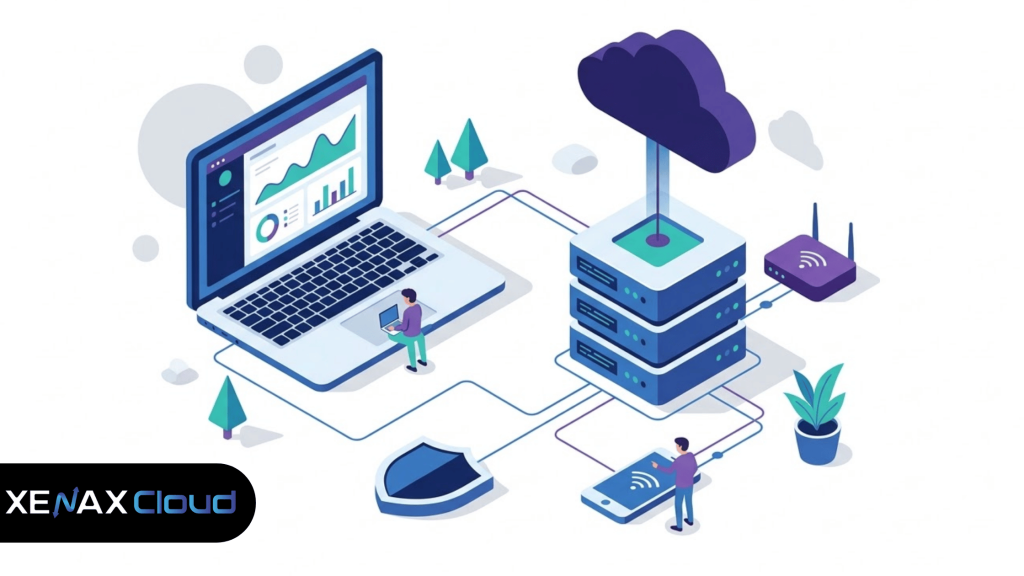
Visitor → Web server → Application → Database → Payment or external service
A bottleneck at any one stage can affect the overall experience.
A dedicated server can give you control over the server-side resources, but it doesn’t automatically solve application-level bottlenecks. Poor database queries, inefficient code, oversized images or badly configured caching can still create problems.
How Much Does a Dedicated Server Cost in India?
Xenax Cloud’s supplied dedicated server pricing is divided between Intel Xeon and AMD EPYC options.
| Processor family | Plan | Listed price/month |
| Intel Xeon | Starter | ₹7,999 |
| Intel Xeon | Pro | ₹11,999 |
| Intel Xeon | Gold | ₹18,999 |
| Intel Xeon | Ultra | ₹27,999 |
| AMD EPYC | Core | ₹15,999 |
| AMD EPYC | Power | ₹22,999 |
| AMD EPYC | Ultra | ₹34,999 |
| AMD EPYC | Titan | ₹59,999 |
These are the supplied monthly prices. The correct plan should be selected using the actual CPU, memory, storage and application requirements rather than price alone.
Xenax Cloud sells AMD EPYC, not Ryzen server processors.
Dedicated servers include a 1 Gbps dedicated port. If an ecommerce operation needs 10 Gbps, that is available through a custom quote rather than one of the listed plans.
Unlimited transfer is also limited to the upper dedicated tiers, so don’t assume it applies to every dedicated server plan.
Dedicated Server vs VPS for Ecommerce
A VPS can be a reasonable starting point for an ecommerce website that doesn’t yet need an entire physical server.
Xenax Cloud lists VPS Speed KVM from ₹599/month. A VPS uses virtualised resources on physical infrastructure and can provide a lower-cost way to host an application.
A dedicated server, by contrast, gives the business the complete physical machine.
| Requirement | VPS | Dedicated server |
| Physical server | Shared physical infrastructure | Entire physical server |
| Resource model | Virtualised | Physical |
| Hardware control | More limited | Greater |
| Starting listed Xenax price | ₹599/month | ₹7,999/month |
| Server administration | Customer-managed depending on service | Customer-managed depending on service |
| Suitable for | Smaller or growing workloads | Workloads requiring dedicated physical resources |
The jump from VPS to dedicated hosting should therefore be based on a real requirement, such as resource demand, application architecture or hardware control.
Database Requirements for Ecommerce Stores
The database often deserves more attention than the storefront itself.
Every product, order, customer record, stock update and transaction can involve database operations. Search and filtering can also generate frequent queries.
A dedicated server lets the business control the database environment more directly. Administrators can choose the database software, configure memory allocation, tune queries and decide how storage is arranged.
But the server cannot compensate for an inefficient database design.
Before moving to dedicated hardware, identify slow queries and determine whether the problem is CPU, memory, storage, indexing or application logic.
This approach helps prevent a common mistake: buying more hardware when the real problem is software configuration.
Storage and Backup Planning
Ecommerce stores usually need storage for more than the application itself.
Product images, invoices, database files, logs, backups and other application data can consume storage over time.
The server’s primary storage should not be treated as the only copy of important business data.
A backup is a separate copy that can be restored if the primary data becomes unavailable or corrupted. Backups should be planned independently from the production server.
The business should also test restoration rather than assuming that a backup file is usable simply because it exists.
For stores handling orders and customer information, backup planning should be part of the server decision from the beginning.
Security Considerations for Ecommerce Servers
An ecommerce server handles applications and data that can be commercially sensitive.
Start with the operating system and server software. Keep supported software patched and remove services that aren’t required.
Use strong administrative credentials and restrict access to management services. If remote administration is required, use appropriate access controls rather than exposing unnecessary services publicly.
HTTPS is also essential for modern ecommerce websites because it encrypts communication between the user’s browser and the website. The exact security architecture will depend on the ecommerce platform and payment setup.
A dedicated server gives administrators more control, but it also means they need to use that control responsibly.
What About Traffic Spikes?
Ecommerce traffic isn’t always predictable.
Sales campaigns, product launches, seasonal shopping and promotional events can produce short periods of unusually high activity.
A dedicated server provides a fixed physical resource pool. That can be useful when the business has a predictable workload and knows what capacity it needs.
However, simply choosing the largest server isn’t a substitute for capacity planning.
Before a major campaign, review application performance, database load, caching, image delivery and external API dependencies.
If the application has multiple components, scaling one server may not address a bottleneck elsewhere.
Should You Choose Intel Xeon or AMD EPYC?
Xenax Cloud offers both Intel Xeon and AMD EPYC dedicated server families.
The processor family alone shouldn’t determine the purchase.
Look at the workload first. A store running a database-heavy application, background processing and multiple services may have different CPU and memory requirements from a simpler storefront.
Also consider the software stack and the administrator’s familiarity with the environment.
Xenax’s listed AMD options start at ₹15,999/month, while Intel Xeon options start at ₹7,999/month.
The right comparison is therefore between the actual specifications of the plans you’re considering, not simply Intel versus AMD as brands.
Moving an Existing Ecommerce Store to a Dedicated Server
Migration should be planned before the new server becomes the production environment.
First, document the current application, database, PHP or runtime version, web server configuration and external integrations.
Create a tested backup of the website and database.
Then configure the new server and test the application without changing the live domain. Check product pages, search, cart, checkout, customer login, order processing and payment integration.
Once the new environment has been tested, plan the DNS change.
After the switch, monitor the application and verify that orders, payments and background processes are functioning correctly.
This approach gives the business a rollback plan instead of treating the DNS change as the entire migration process.
FAQs
Is a dedicated server necessary for every ecommerce website?
No. Smaller stores can often operate on shared hosting or VPS infrastructure. Dedicated hosting becomes more relevant when the workload requires greater physical resources or server control.
What is an ecommerce dedicated server?
An ecommerce dedicated server is a physical server allocated to one business and used to run its ecommerce application, database and related services. The business receives the resources and administrative control of that server.
Is a dedicated server suitable for a high traffic website?
It can be suitable when the website requires dedicated physical resources. However, traffic volume alone doesn’t determine the required server specification, because application architecture and database workload also affect capacity.
Does Xenax Cloud offer 10 Gbps dedicated servers?
The supplied information states that dedicated servers include a 1 Gbps dedicated port. A 10 Gbps connection is available through a custom quote rather than a listed plan.
Does Xenax Cloud use AMD Ryzen processors for dedicated servers?
No. The supplied product information specifies AMD EPYC for its AMD dedicated server range, not Ryzen.
The Next Step
If your ecommerce store is already approaching the limits of its current infrastructure, document the CPU, memory, storage, database and traffic requirements before selecting a dedicated server.
Xenax Cloud’s dedicated range starts at ₹7,999/month for the listed Intel Xeon Starter plan, with a 15-day money-back window on every plan under the supplied terms. Review the available dedicated configurations before deciding whether moving from a VPS to physical hardware is justified.