
A privacy notice for website India explains what personal data a business collects, why it processes that information and how visitors can exercise applicable privacy rights. Indian website owners should prepare their notices around the Digital Personal Data Protection Act, 2023 and the DPDP Rules, 2025, while checking their actual processing activities and the applicable commencement dates.
A website collecting names, phone numbers, email addresses or customer account details should explain how those details are handled. A generic statement saying that information is collected to improve services does not adequately describe the individual purposes of processing.
This article explains the information to include, how consent works, how to publish a notice and how to select suitable hosting for a business website.
What Is a Privacy Notice for Website India?
A privacy notice for website India is a document that informs visitors about the personal data a website processes, the purposes of processing and the choices available to individuals.
The Digital Personal Data Protection (DPDP) Act, 2023 establishes India’s framework for processing digital personal data. A Data Fiduciary is the person or organisation that determines the purpose and means of processing personal data, while a Data Principal is the individual to whom that personal data relates.
For example, when someone submits a business enquiry form containing their name, email address and telephone number, the business operating the website determines how those details are used to handle the enquiry.
A privacy notice should explain this activity in plain language. It should reflect the actual website configuration rather than copy another company’s policy without checking its forms, plugins, analytics and external services.
Common websites that should review their privacy practices include:
- Business websites collecting sales enquiries.
- Online stores processing customer and delivery information.
- Educational websites collecting student registrations.
- Membership websites maintaining user accounts.
- Professional service websites collecting appointment requests.
The DPDP framework concerns digital personal data. A website operator should therefore identify the information it actually processes and determine which legal requirements apply to those activities.
What Should a Privacy Notice for Website India Include?
A privacy notice for website India should explain the personal data collected, the specific purposes of processing and the relevant choices available to individuals.
Rule 3 of the DPDP Rules, 2025 specifies that a notice must be understandable independently of other information. It requires an itemised description of personal data and the specific purposes for processing, together with information that enables individuals to make informed decisions.
A practical notice should cover the following areas.
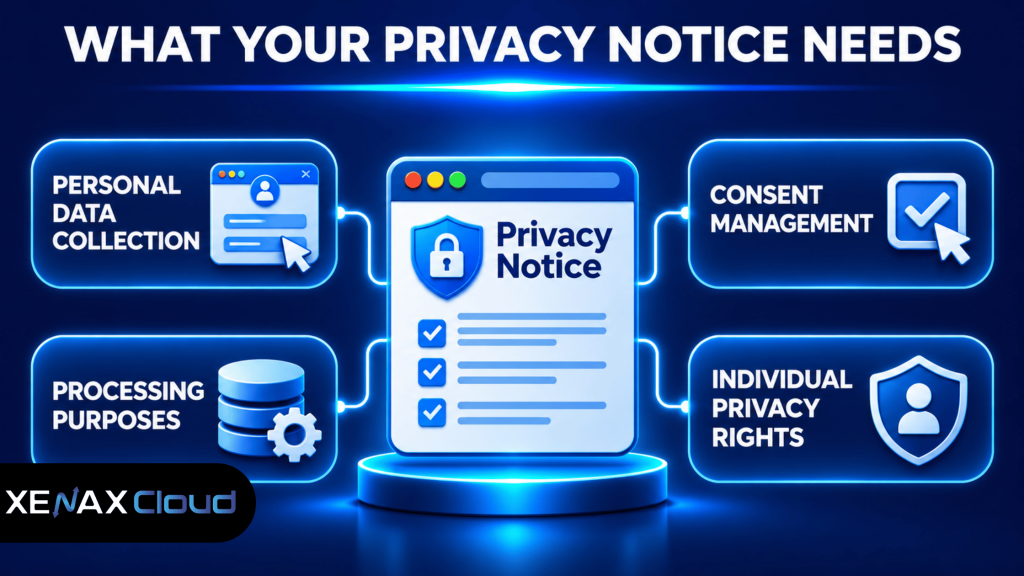
1. Business identity and contact details
Identify the organisation responsible for processing personal data. Include a working contact channel for privacy-related questions and grievances.
2. Personal data collected
List the information your website actually collects. This may include names, email addresses, phone numbers, billing details, delivery addresses and account information.
3. Purpose of processing
Explain why each category is needed. For example, a contact form may collect an email address to respond to a service enquiry.
4. Consent and user choices
Explain how individuals can give or withdraw consent when consent is the applicable legal basis. Provide an accessible method for exercising these choices.
5. Data retention and security
Explain the applicable retention period or criteria used to determine retention. Describe the security safeguards you actually maintain without promising that data can never be compromised.
6. Privacy rights and grievances
Explain how individuals can exercise applicable rights and contact the organisation about privacy concerns.
A useful way to organise the information is to connect every data category with its purpose.
| Data category | Processing purpose | Website example |
| Name | Identify the individual | Contact form |
| Email address | Respond to enquiries | Business website |
| Phone number | Communicate about requests | Appointment form |
| Delivery address | Fulfil orders | Online store |
| Account information | Maintain user access | Membership website |
Do not copy every row into your notice automatically. Include only the categories that your website actually processes.
What Is a DPDP Privacy Notice Under Indian Law?
A DPDP privacy notice is information provided by a Data Fiduciary to help individuals understand the processing of their personal data.
The DPDP Act, 2023 and the DPDP Rules, 2025 establish the legal framework for this process. The notice requirements are designed to make the information understandable and specific instead of hiding important details inside lengthy legal documents.
For example, an online stationery store may collect a customer’s name, email address, telephone number and delivery address. Its notice should explain that the information is used for order processing, transaction communication and delivery rather than combining every activity under a vague purpose.
The legal commencement dates matter when preparing your website. The Act and Rules were notified on 13 November 2025, but their provisions have staggered commencement dates.
As of 21 November 2026:
- Rule 3 of the DPDP Rules, covering notice requirements, is scheduled to commence on 13 May 2027.
- Rule 4 commenced on 13 November 2026.
- Most substantive provisions of the Act, including Sections 3 to 5, are scheduled to commence on 13 May 2027.
This means businesses should prepare their notices in advance without incorrectly claiming that every substantive requirement is already in force.
Read the official Digital Personal Data Protection Rules, 2025 for the notified text and commencement provisions.
How Should a Consent Notice DPDP Be Written?
A consent notice DPDP should explain the specific personal data being collected and the purpose of processing before asking an individual to agree.
Consent should not be hidden inside unrelated terms and conditions. A visitor should be able to understand what they are agreeing to and make a meaningful choice.
Consider this example for a business enquiry form:
Business Enquiry Form
Name: [Enter your name]
Email: [Enter your email]
Phone: [Enter your phone number]
[ ] I agree to the processing of my
personal information to respond to
this enquiry.
[Submit Enquiry]
Privacy Notice
This is an illustrative consent-based workflow, not a universal checkbox requirement. The business must determine the appropriate legal basis for each processing activity.
Marketing communication should also be considered separately. Someone submitting an enquiry should not automatically be treated as having agreed to unrelated promotional messages.
Where consent is the applicable basis, withdrawal should be as easy as giving consent. Businesses should provide a practical method instead of requiring individuals to navigate unrelated departments or complicated procedures.
How to Add a Privacy Notice to Your Website?
You can add a privacy notice by preparing an accurate document, publishing a dedicated page and linking it wherever your website collects personal information.
Follow these steps:
- Inventory every contact form, registration field and data collection tool.
- Identify the personal information collected through each feature.
- Document the specific purpose of each data category.
- Review analytics, payment tools and third-party integrations.
- Draft the notice using clear language and accurate contact details.
- Publish a dedicated Privacy Notice page.
- Link the page beside relevant forms and in the website footer.
For WordPress websites, create the page through the administration dashboard:
WordPress Dashboard
Pages
> Add New
> Title: Privacy Notice
> Add privacy notice content
> Publish
To add the link to your website footer, use the appropriate navigation editor for your theme:
WordPress Dashboard
Appearance
> Editor
> Navigation or Footer
> Add Privacy Notice link
The exact menu depends on the active WordPress theme. Some themes provide a separate footer menu under Appearance > Menus.
After publishing, open the page on desktop and mobile. Submit a test enquiry to confirm that the notice link works and the form behaves as described.
Do Cookies, Analytics and Contact Forms Affect Your Privacy Notice?
Cookies, analytics and contact forms can involve personal data processing, so your privacy notice should accurately describe their use.
A cookie is a small piece of information stored by a browser or device to maintain settings, remember sessions or support website functions. Analytics tools may also collect information about website visits, devices and user interactions.
Review these components before publishing your notice:
- Contact forms: Identify the fields collected and where submissions are delivered.
- Analytics: Check the analytics provider and the information it processes.
- Marketing tools: Review mailing-list subscriptions and tracking integrations.
- Payment gateways: Explain relevant payment processing and external service providers.
- Embedded services: Review maps, videos and other third-party integrations.
A common mistake is writing that a website does not track visitors while an analytics plugin or marketing script is active. Check the installed WordPress plugins, theme integrations and external scripts before making that statement.
Website security is equally important when handling visitor information. Read our guide on best WordPress security plugins to understand malware protection, login security, firewall protection and website monitoring.
Worked Example: Privacy Notice for a CA Firm Website in India
Consider a Lucknow-based chartered accountancy firm with one business website and three employees handling customer enquiries.
The website collects a visitor’s name, email address, phone number and enquiry description. The firm uses these details to respond to service requests and does not require visitors to upload financial documents through its public contact form.
Its privacy notice should explain each collected field, its purpose, who can access the enquiries and the retention criteria followed by the firm. If the website also uses analytics or promotional mailing tools, those activities need separate consideration.
Which Xenax Cloud Hosting Plan Fits This Website?
Xenax Cloud Shared Hosting Silver is a suitable configuration to evaluate for this example because the firm needs one website, business mailboxes and an included backup arrangement.
The Silver configuration includes:
- 1 website.
- 5 GB disk storage.
- 50 GB bandwidth.
- 3 mailboxes.
- JetBackup 5 backups included.
The smaller Mini Hosting Beginner configuration supports 1 website and 1 GB storage but does not include email or backups. It therefore does not meet the firm’s stated requirements for business mailboxes and included backups.
Use this decision rule:
- Choose Mini Hosting Beginner if you need 1 website, up to 1 GB storage and do not require included email or backups.
- Choose Shared Hosting Silver if you need 1 website, 5 GB storage and up to 3 mailboxes.
- Choose Shared Hosting Gold if you need up to 3 websites, 15 GB storage and 6 mailboxes.
- Choose Shared Hosting Platinum if you need up to 10 websites, 100 GB storage and 25 mailboxes.
Shared Hosting Silver is not the right choice if the firm needs multiple websites or substantially more storage. Evaluate Gold or Platinum according to the number of sites and storage requirements.
Xenax Cloud provides cPanel hosting with LiteSpeed, Let’s Encrypt SSL included and DDoS protection. These infrastructure features support website operation but do not automatically establish legal compliance.
You can compare the available Xenax Cloud Shared Hosting configurations before selecting a suitable configuration.
Common Privacy Notice Mistakes Website Owners Should Avoid
A privacy notice can mislead visitors if it describes generic practices instead of the website’s actual data collection and processing activities.
Avoid these mistakes:
Copying another company’s privacy policy: Its data categories, service providers and retention practices may differ from yours.
Using vague processing purposes: Statements such as “we use information for business purposes” do not explain why specific information is collected.
Ignoring third-party integrations: Analytics, payment tools and embedded services may process information outside your own website.
Adding a blanket consent checkbox: Different processing activities can have different legal bases. Do not assume one checkbox covers every activity.
Providing an inactive privacy contact: A contact address that nobody monitors does not give visitors a practical way to raise concerns.
Making unsupported security promises: Avoid claiming that customer information is completely secure or that a data breach is impossible.
Before updating your notice, save a copy of the existing version and test all updated links and forms. This provides a reference if a website change accidentally removes an important privacy notice or consent control.
privacy notice for website india: FAQs
Is a privacy notice mandatory for every website in India?
A privacy notice is an important way to explain how a website handles personal data, but legal obligations depend on the applicable law and its commencement. Website owners should identify their data processing activities and prepare appropriate disclosures rather than assuming that every website has identical requirements.
What is the difference between a privacy notice and a privacy policy?
A privacy notice explains specific data collection activities, processing purposes and individual choices. A privacy policy is commonly used as a broader document describing an organisation’s privacy practices. A business can combine this information in one document if it remains clear and satisfies applicable legal requirements.
Does every website need a consent checkbox under DPDP?
No, a consent checkbox is not automatically required for every website activity. The DPDP framework recognises consent and certain permitted legitimate uses as different grounds for processing. Where consent is required, provide the relevant information before requesting agreement and make withdrawal accessible.
What information should a DPDP privacy notice contain?
A DPDP privacy notice should identify the personal data collected, specify the processing purposes and explain the relevant choices available to individuals. It should also provide accessible information about withdrawing consent, exercising applicable rights and submitting grievances. The notice should use clear language and accurately reflect actual website practices.
Do WordPress websites need a separate privacy notice?
WordPress websites processing personal data should provide an accessible explanation of their privacy practices. Contact forms, account registration, analytics and marketing plugins can collect different information. Review installed plugins and external integrations before preparing the notice, and link it near the relevant forms and in the footer.
How often should a website privacy notice be updated?
Update a website privacy notice whenever data collection, processing purposes, third-party integrations or privacy contact details change. Review the document periodically and maintain dated copies of published versions. This helps your organisation identify which privacy information was available when a particular data collection activity occurred.
Can a website collect personal data without consent under DPDP?
Yes, the DPDP Act recognises certain permitted legitimate uses in addition to consent-based processing. However, businesses must identify the applicable legal basis and satisfy its conditions. A general privacy notice does not automatically authorise the collection of unrelated personal information.
For a single business website requiring 5 GB storage, 50 GB bandwidth, 3 mailboxes and included JetBackup 5 backups, evaluate Xenax Cloud Shared Hosting Silver. Choose Gold or Platinum if your website count or storage requirements exceed Silver’s limits.