If you are building a website for the first time, hosting vs domain can be confusing. Both are necessary for most websites, but they perform completely different jobs. A domain gives your website its address, while hosting provides the server space where your website files, databases, and applications are stored.
Understanding this difference before purchasing a hosting plan or domain can help you avoid choosing the wrong service. It can also make it easier to estimate your website’s requirements as your business grows.
Indian hosting infrastructure can be a practical choice for both local and international website owners. Cost-effective resources, strong connectivity across Asia, competitive global performance, reliable infrastructure, and scalable hosting options make India an attractive location for many online businesses.
This hosting vs domain guide explains what each service does, how they work together, what you actually need to launch a website, and which hosting option may be suitable for different types of projects.
Understanding hosting vs domain before starting a website can help beginners choose the right services from the beginning.
Hosting vs Domain: What Is the Difference?
The easiest way to understand hosting vs domain is to think about a physical business.
Your domain name is like the address customers use to find your business. Your web hosting is like the building where your business, products, and equipment are actually located.
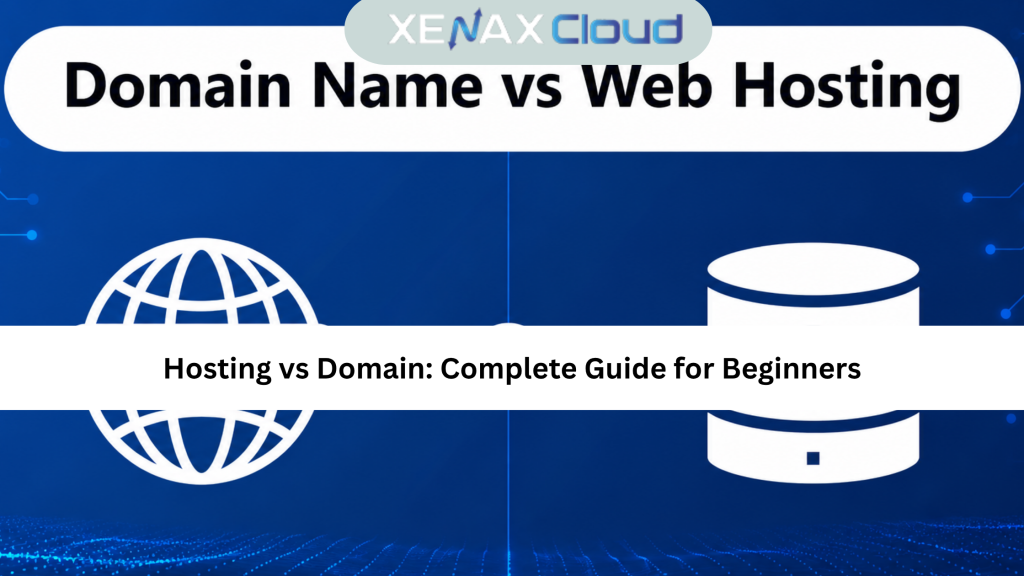
A domain is a human-readable website address such as example.com. Hosting is the server infrastructure that stores the website’s files and delivers them when someone visits the domain.
You can register a domain without immediately purchasing hosting. Similarly, you can purchase hosting without registering a domain, although you will generally need a domain or another method of accessing the server when launching a public website.
This basic hosting vs domain difference is important because both services have separate roles in a website.
What Is a Domain?
A domain is the unique address people type into a browser to reach your website.
For example:
example.com
A domain normally consists of a name and extension, such as .com, .org, .net, or a country-specific extension.
When someone enters your domain into their browser, the Domain Name System, or DNS, helps direct that request toward the appropriate server.
A domain itself does not store your website’s pages, images, databases, or application files. It acts as the address that points visitors toward the appropriate online destination.
What Is Web Hosting?
Web hosting provides the server resources required to store and deliver your website.
Depending on the hosting type, those resources can include:
- CPU
- RAM
- Storage
- Bandwidth
- Database services
- Web-server software
- Email services
- Security tools
When someone visits your website, the hosting server processes the request and sends the required website content back to the visitor’s browser.
This is why understanding hosting vs domain is important. The domain helps visitors find your website, while hosting provides the infrastructure that makes the website accessible.
How Hosting and Domain Work Together
A domain and hosting are separate services, but they normally work together when you launch a website.
Suppose you register:
mybusiness.com
You then purchase a hosting plan and upload your website files to the hosting server.
The domain’s DNS settings are configured to point toward that hosting environment. When a visitor enters mybusiness.com, the DNS system helps route the request to the correct server.
The server then returns the website’s content to the visitor.
This relationship is one of the most important concepts covered in a hosting vs domain tutorial because beginners sometimes assume that buying a domain automatically creates a website.
It does not. A domain provides the address, while hosting provides the environment where the website operates.
Why Indian Hosting Servers Are a Smart Choice
Choosing the right hosting location can influence network performance, especially when most of your visitors are concentrated in a particular region.
Indian hosting infrastructure can be a strong option for businesses serving customers in India and other Asian markets while still supporting international audiences.
Cost-Effectiveness
Different hosting environments allow businesses to choose resources according to their actual needs. A small website does not necessarily require a high-resource server.
For example, a simple business website may work well with shared hosting, while a growing web application may need a VPS with more CPU and RAM.
Selecting resources according to actual usage helps avoid paying for infrastructure that the website does not need.
Low Latency Across Asia
India provides a useful geographic position for audiences across South Asia and several nearby Asian markets.
Businesses serving visitors in India, Singapore, UAE, Bangladesh, Nepal, and other nearby regions can benefit from hosting infrastructure that is relatively close to their users.
International performance depends on network routing, distance, bandwidth, and application optimization, so server location should be considered alongside these factors.
Security, Reliability, and Compliance
Hosting security depends on more than location. Firewalls, software updates, backups, access controls, SSL certificates, and monitoring all contribute to a secure hosting environment.
Businesses should also evaluate their own data-handling and compliance requirements before selecting a server location.
Scalability for International Businesses
A website can start small and grow quickly. Scalable hosting makes it possible to increase resources when traffic, databases, or application requirements become larger.
This is especially useful for startups and agencies that may begin with a basic website and later require VPS or dedicated infrastructure.
Types of Web Hosting
Understanding the different hosting options makes the hosting vs domain comparison easier because hosting is available in several forms.
Shared Hosting
Shared hosting places multiple websites on the same physical server environment.
It is generally suitable for:
- Personal blogs
- Portfolio websites
- Small business websites
- New websites
- Low to moderate traffic
The main advantage is simplicity. The hosting provider handles much of the underlying server management, making shared hosting a practical option for beginners.
VPS Hosting
A Virtual Private Server provides an isolated virtual environment with allocated CPU, RAM, storage, and bandwidth.
VPS hosting is useful for:
- Growing websites
- Web applications
- APIs
- Development environments
- Databases
- Business applications
It offers more control and flexibility than typical shared hosting.
For businesses that need additional control over their server environment, XenaxCloud’s VPS Hosting is a relevant option.
Dedicated Server
A dedicated server provides an entire physical server to one customer.
It is generally used for high-resource workloads such as:
- High-traffic websites
- Large databases
- Enterprise applications
- Resource-intensive software
- Custom server environments
Dedicated servers provide substantial resources and control but generally require more technical administration.
How to Choose the Right Hosting Plan
When comparing hosting vs domain, remember that your domain does not determine how powerful your website infrastructure needs to be. Your hosting plan should be selected according to the website or application you intend to run.
Consider Website Traffic
Estimate how many visitors you expect and how resource-intensive your website will be.
A basic informational website may require relatively few resources, while an online store with product databases and dynamic pages can require significantly more CPU and RAM.
Check Storage Requirements
Consider the size of your website files, images, videos, databases, backups, and future content.
A small website may require only a few gigabytes, while a media-heavy project may need considerably more storage.
Evaluate Bandwidth
Bandwidth determines how much data can move between your server and visitors.
A website with large images, downloads, or video content can consume more bandwidth than a simple text-based website.
Think About Future Growth
Do not select a hosting plan based only on today’s requirements. If you expect traffic or application usage to grow, consider whether the provider offers easy upgrades.
This makes scaling simpler when your website starts receiving more visitors.
Recommended Hosting Options for Different Websites
| Website Type | Suitable Hosting | Main Reason |
|---|---|---|
| Personal Blog | Shared Hosting | Simple management |
| Portfolio Website | Shared Hosting | Low resource needs |
| Small Business Website | Shared Hosting | Easy to manage |
| Growing Website | VPS | More resources and control |
| Web Application | VPS | Flexible configuration |
| Large Database | Dedicated Server | Higher hardware capacity |
| Enterprise Application | Dedicated Server | Maximum control |
For a beginner, shared hosting can be a sensible starting point when the website has modest requirements. A growing business may eventually move to VPS hosting as traffic and application complexity increase.
Recommended XenaxCloud Hosting Plans
For smaller websites, XenaxCloud offers several shared hosting options. The supplied brief lists Silver — 1 Website, 15GB Storage, 100GB Bandwidth, $1.79, Gold — 3 Websites, 25GB Storage, 500GB Bandwidth, $2.39, Platinum — 10 Websites, 100GB Storage, 1000GB Bandwidth, $4.19, and Diamond — Unlimited Websites, Unlimited Storage, Unlimited Bandwidth, $7.19.
For a growing website or application that needs more control, KVM VPS 2 — 4 Vcore CPU, 16GB RAM, 50GB Storage, 4TB Bandwidth, $10.79 is a balanced option.
The most suitable plan depends on your website’s traffic, storage requirements, applications, and expected growth.
Speed, Uptime, and Security Advantages
Understanding hosting vs domain is only the first step. Once your domain is connected to a hosting server, the quality of that hosting environment affects website speed, availability, security, and scalability.
Website Speed
Website speed depends on several factors, including server resources, storage performance, network latency, website code, databases, images, caching, and content delivery.
A lightweight business website may perform well on shared hosting, while a dynamic application with frequent database requests may need VPS resources.
Uptime and Reliability
A website needs reliable infrastructure to remain accessible to visitors. Stable networking, sufficient resources, monitoring, maintenance, and backups all contribute to a dependable hosting environment.
Your domain can remain registered even if your hosting server has a problem, but visitors will not be able to use the website normally until the hosting issue is resolved.
Security
Website security should include SSL certificates, strong account passwords, software updates, secure access controls, backups, and appropriate server configuration.
A domain and hosting account should also be protected separately. Securing only one part of your website setup is not enough.
Real-World Use Cases for Businesses and Developers
The practical difference between hosting vs domain becomes easier to understand when you look at how businesses use both services.
Small Business Website
A local business may register a memorable domain and use shared hosting for a simple website containing services, contact information, images, and business details.
The domain gives customers an easy address, while hosting stores and delivers the website.
Online Store
An e-commerce website usually requires more resources because it may contain product databases, customer accounts, payment integrations, images, and dynamic pages.
A growing store may start with shared hosting and later move to VPS hosting when its traffic and application requirements increase.
Developer Project
Developers may register a domain for an application and use a VPS to host the backend, API, database, or development environment.
The domain provides a recognizable public address, while the VPS provides the computing environment.
Agency Websites
A digital agency managing multiple client websites may register separate domains and host them under suitable shared, reseller, or VPS environments.
This makes resource planning important because different client projects may have very different hosting requirements.
Why Indian Servers Can Handle Global Traffic Efficiently
Indian hosting infrastructure can be a practical choice for businesses serving customers in India and other Asian markets while still supporting international audiences.
Strong Asian Connectivity
India’s geographic position makes it suitable for businesses whose primary visitors are located in India and nearby Asian regions.
Users in India, Singapore, UAE, Bangladesh, Nepal, and other nearby markets may benefit from infrastructure that is relatively close to them.
Competitive International Performance
Global performance depends on more than server location. Network routing, bandwidth, application optimization, caching, and CDN services can all influence how quickly users receive website content.
An Indian origin server can therefore support international traffic effectively when the website and network architecture are properly configured.
Scalable Infrastructure
Businesses should have the ability to increase CPU, RAM, storage, and bandwidth as their workload grows.
This is especially useful for startups that may begin with a small website and later develop into a larger application or online business.
Comparison: Indian Servers vs Foreign Regions
The following comparison focuses on regional performance, support, provisioning, reliability, and scalability. It does not compare hosting prices.
| Feature | India | USA | Canada | Germany | UAE |
|---|---|---|---|---|---|
| Asia Performance | Excellent | Moderate | Moderate | Good | Very Good |
| Global Connectivity | Very Good | Excellent | Excellent | Excellent | Very Good |
| 24/7 Technical Support | Available | Available | Available | Available | Available |
| Transparent Pricing | Yes | Yes | Yes | Yes | Yes |
| Fast Provisioning | Excellent | Excellent | Excellent | Excellent | Excellent |
| Reliability | Excellent | Excellent | Excellent | Excellent | Very Good |
| Scalability | Highly Scalable | Highly Scalable | Highly Scalable | Highly Scalable | Scalable |
Actual website performance can vary based on visitor location, network routing, application architecture, server resources, and content optimization.
Scalability Options for Startups and Agencies
A new website may have limited resource requirements, but those requirements can change as traffic increases. This is why scalability should be considered when comparing hosting vs domain options.
A domain itself does not become more powerful as traffic grows. Your hosting environment is what needs to scale.
For smaller websites, Silver — 1 Website, 15GB Storage, 100GB Bandwidth, $1.79 can provide a suitable shared hosting environment.
For multiple websites, Gold — 3 Websites, 25GB Storage, 500GB Bandwidth, $2.39 provides additional website and bandwidth capacity.
For growing applications that need greater server control, KVM VPS 2 — 4 Vcore CPU, 16GB RAM, 50GB Storage, 4TB Bandwidth, $10.79 is a stronger option.
The important point is to upgrade the hosting environment when resource usage consistently approaches its limits rather than purchasing an unnecessarily large plan from the beginning.
Frequently Asked Questions
What is the difference between hosting and a domain?
A domain is your website’s address, while hosting provides the server space and resources used to store and deliver your website.
Do I need both a domain and hosting?
Most public websites need both. The domain gives visitors an address to reach the website, while hosting provides the infrastructure where the website files and applications run.
Can I buy a domain without hosting?
Yes. You can register a domain separately and connect it to hosting later. The domain can remain registered even when no website is currently hosted on it.
Can I buy hosting without a domain?
Yes. You can purchase hosting without immediately registering a domain, although you will need a domain or another access method when you are ready to publish a public website.
Which is more important, hosting or domain?
Neither replaces the other. A memorable domain helps visitors find your website, while suitable hosting determines the resources and infrastructure available to run it.
Conclusion
Understanding hosting vs domain is essential before launching a website. A domain provides the address people use to find your website, while hosting provides the server infrastructure that stores and delivers your website’s content.
The two services work together, but they should not be confused. Your domain does not provide CPU, RAM, storage, or bandwidth, and hosting does not automatically give your website a memorable public address.
For a small website, shared hosting can be a practical starting point. As traffic, applications, databases, and business requirements grow, moving to VPS hosting can provide additional control and resources.
For businesses targeting India and Asia, Indian hosting infrastructure can offer a practical combination of regional connectivity, scalable resources, and global reach. XenaxCloud provides hosting options for different website requirements, from shared hosting to VPS infrastructure.
Choose your hosting plan according to your actual traffic, storage, bandwidth, application requirements, and future growth. The latest deals and discounts are available on the XenaxCloud Offers Page, while the supplied brief specifies a 15-day money-back guarantee for the hosting CTA.
Ready to launch your website? Choose the right XenaxCloud hosting plan and connect your domain to a reliable hosting environment.