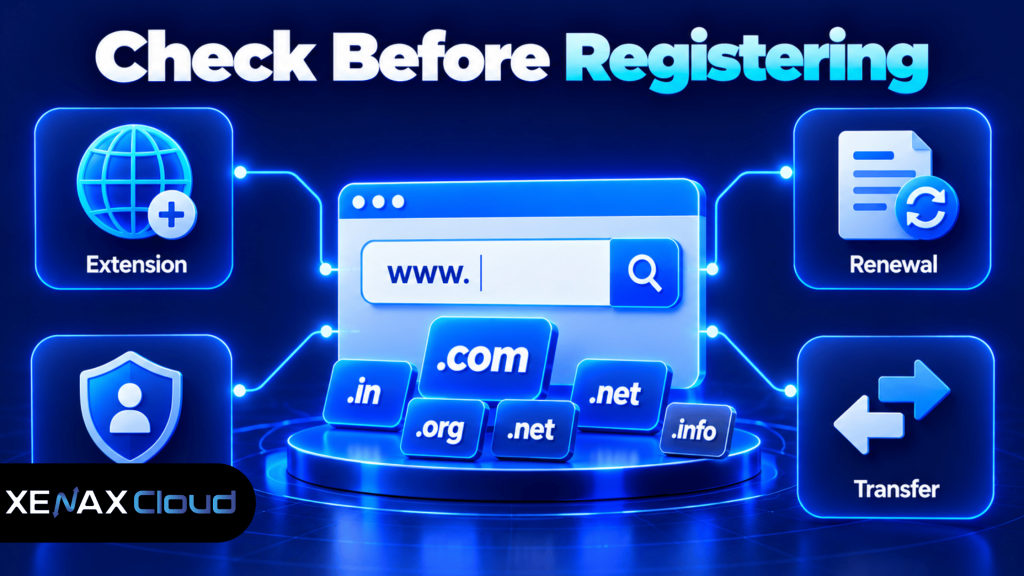
A buy domain offer should be evaluated by more than its advertised registration price. Check the domain extension, renewal terms, ownership details, transfer conditions and included services before registering. A useful offer is one whose total terms remain suitable after the initial registration period.
A domain name is a human-readable address that identifies a website or other internet service. The registration is not the same as buying permanent ownership of the name.
For an Indian business, creator, professional or startup, the right choice starts with the name itself and then moves to extension, registrar terms and long-term renewal.
What Is a Domain Name Offer?
A domain name offer is a registration promotion or commercial deal presented around a particular domain extension or registration service.
A domain registrar is a service that processes domain registrations and manages settings such as nameservers, renewal and transfer.
An offer can look attractive because the initial registration cost is highlighted, but the renewal terms may be more relevant if you plan to keep the domain for several years. ICANN states that registrants have rights to information about registration, management, transfer, renewal and restoration processes.
A sensible domain name offer should therefore be evaluated across several factors:
- Registration price
- Renewal price
- Domain extension
- Registration period
- Transfer conditions
- DNS management
- Contact and ownership controls
- Available support
- Any included services
The word “offer” should not automatically mean “best choice”. A cheaper first registration can become less attractive if its renewal terms, transfer restrictions or service conditions do not suit your plans.
For business domains, also consider how easy the name is to spell, remember and communicate verbally. A short name with an appropriate extension can reduce confusion for customers and employees.
How Do You Compare a Buy Domain Offer?
A buy domain offer should be compared using both immediate registration terms and the ongoing cost and conditions of keeping the domain.
The most common mistake is comparing only the first-year price. The domain’s renewal price should also be checked before registration because the initial and renewal prices can differ.
| Factor | What to check | Why it matters |
| Extension | .com, .org, .net, .xyz, .online | Affects branding and availability |
| Registration | First-year terms | Shows the initial commitment |
| Renewal | Future renewal price | Affects long-term cost |
| Ownership | Registrant information | Establishes control of the registration |
| Transfer | Transfer eligibility and process | Helps if you change registrar |
| DNS | Nameserver and DNS controls | Determines how services connect |
ICANN explains that a domain registrant enters into a contract with the registrar and has rights concerning registration, management, transfer and renewal information.
A domain name offer is therefore more than a checkout screen. You should understand who the registered name holder is, which account controls it and what happens when the registration approaches expiration.
A useful comparison also checks the registration period. ICANN notes that generic domain registrations are commonly registered for periods ranging from one to ten years, subject to applicable registry and registrar rules.
That matters because the registration period determines how long the domain remains registered before renewal becomes necessary. Your registrar account should also contain accurate contact information so renewal and administrative notices reach the correct person.
Which Domain Extensions Can You Register?
Xenax Cloud provides several domain extensions, including .com, .org, .net, .com.in, .xyz and .online.
A top-level domain, or TLD, is the final part of a domain name that identifies its namespace, such as .com or .org.
The choice of extension should follow the purpose of the website rather than the promotion alone.
A business targeting a broad audience may prefer .com when the desired name is available. An organisation may consider .org where that extension accurately reflects its purpose, while newer extensions can be useful when the preferred name is unavailable under a traditional extension.
Xenax Cloud provides domain registration through its domain registration service, where available extensions can be checked before registration.
Do not register several extensions simply because they appear in an offer. Register additional names when they have a clear purpose, such as protecting a brand spelling or supporting a separate project.
How to Check a .com Domain Offer Before Buying?
A .com domain offer should be checked for availability, registration terms, renewal conditions and ownership details before checkout.
A .com domain is a generic top-level domain widely used for commercial and general-purpose websites. Its familiarity makes it a common first choice for businesses, but availability of the exact name can be the limiting factor.
If the preferred .com name is available, check these items before registering:
- Confirm the exact spelling.
- Check the registration period.
- Compare renewal terms.
- Verify the registrant account.
- Review transfer conditions.
- Confirm DNS management access.
- Check the registrar’s support process.
The exact name matters because a spelling variation can create confusion between your website, email addresses and marketing material.
Do not select a domain only because the first registration price looks attractive. ICANN gives registrants access to information about registrar terms, including registration and renewal processes, so those terms should be reviewed before committing.
A business should also search for obvious spelling variants before publishing the chosen domain. This is a branding check rather than a technical requirement, but it can prevent customers from reaching a different website by mistake.
How to Buy a Domain Safely?
You can buy a domain safely by verifying the name, registrar account, renewal terms and ownership information before completing registration.
Steps to Buy a Domain Safely
- Search the exact domain name.
- Confirm the spelling and extension.
- Review registration and renewal terms.
- Create or verify your registrar account.
- Enter accurate registrant information.
- Confirm the registration period.
- Check nameserver and DNS access.
- Save the registration records securely.
The registrant information should belong to the person or organisation that should control the domain. Do not register a business-critical domain under an employee’s personal account if the business is supposed to control it.
After registration, record the registrar, domain name, account owner and renewal date in your business documentation.
Enable renewal reminders and keep the payment method and account contact information current. ICANN specifically advises registrants to keep their contact information updated so they receive renewal and other important notices.
For a domain connected to business email, verify DNS records after registration before changing nameservers. An incorrect DNS change can interrupt website or email services even though the domain itself remains registered.
Worked Example: A Lucknow Business Choosing a Domain
A Lucknow accounting consultancy is launching a website and wants one main domain for its website, email and printed marketing material.
The preferred brand name is available as .com, while a shorter alternative is available under another extension. The business expects to use the same domain for its website and email, so the domain should be treated as a long-term business asset rather than a temporary campaign address.
The .com option fits if its spelling is clear, the registrant account is controlled by the business and its renewal terms are acceptable. The alternative extension would make more sense only if the preferred .com name is unavailable or the alternative has a clear branding reason.
The decision rule is simple:
- Choose .com when the preferred business name is available and its renewal terms fit the business.
- Choose .org when the organisation’s purpose genuinely matches the extension.
- Choose .xyz or .online when the name and extension clearly fit the project and the preferred traditional extension is unavailable.
- Choose an additional extension only when it protects a meaningful brand variant or serves a separate purpose.
For this consultancy, registering a second domain merely because it appears in an offer adds another renewal obligation without necessarily adding business value.
What Should You Check After Buying a Domain?
After buying a domain, confirm ownership information, DNS settings, renewal status and account access.
The first post-registration check should be the registrar account. Confirm that the domain appears under the correct account and that the registered contact information belongs to the intended person or organisation.
Next, verify the nameservers. If the domain will point to a website hosted elsewhere, the DNS configuration should match the hosting provider’s instructions.
For business email, verify the required DNS records before moving mail services. Changes to nameservers or DNS records can affect website and email delivery.
Keep a record of:
- Domain name
- Registrar account
- Registrant details
- Renewal date
- Nameservers
- DNS records
- Authorised administrators
states that registrants have responsibilities around accurate registration information and keeping account details current.
A practical safety step is to store domain account recovery information securely and ensure that more than one authorised business decision-maker knows which account controls the domain, without sharing passwords.
Can You Transfer a Domain to Another Registrar?
A domain can generally be transferred between registrars when the registration and transfer rules allow it.
Domain transfer means moving the registration management from one registrar to another while retaining the domain name. Hosting and registrar services are separate, so changing your web host does not automatically require transferring the domain.
ICANN states that registrants have the right to transfer domain registrations between registrars, subject to applicable policy restrictions.
Transfer requirements can include an authorisation code and specific eligibility conditions. Some registrations can also be subject to transfer locks after registration or changes to registrant information.
The important point is that a buy domain offer should not be judged by transfer convenience alone. Check the registrar’s transfer process before registration if you already expect to move the domain later.
What Happens If You Forget to Renew a Domain?
A domain can expire if it is not renewed, and an expired domain may eventually become available for registration by another person.
Domain expiration can affect the website and associated email because those services depend on the domain remaining registered. ICANN advises registrants to understand their registrar’s renewal and expiration procedures.
The recovery process depends on the domain’s lifecycle stage and registrar policies. A domain that has progressed toward deletion can become more difficult to recover, so waiting until expiration is a poor operational practice.
For a business domain, set reminders before the renewal date and keep the registrar account’s contact and payment information current.
A common misconception is that owning a domain means owning it permanently. Domain registration grants use of the name for the registered period; continued use requires renewal.
Is a Buy Domain Offer Always Worth Taking?
A buy domain offer is worth considering only when the domain name, extension, renewal terms and ownership conditions all fit your actual use.
An offer should be rejected when the name is difficult to spell, the extension does not match the organisation, the renewal terms are unsuitable or the domain would be controlled by the wrong person.
Xenax Cloud supports domain extensions including .com, .org, .net, .com.in, .xyz and .online. Domain registration is separate from web hosting, so registering a domain does not automatically mean that a website or email service is included.
If you already have hosting elsewhere, you can still register the domain separately and point its DNS records to the required services.
For an Indian business paying through Indian gateways, Xenax Cloud supports Paytm, Cashfree and PayU for UPI, cards and net banking, along with an international gateway for foreign cards. Support is available 24/7.
buy domain offer: FAQs
Is a buy domain offer cheaper than regular registration?
A buy domain offer may reduce the initial registration cost, but the long-term value depends on renewal terms and included services. Compare the first-year price with the renewal price before registering. Also check transfer conditions, DNS controls and ownership information so the promotion does not hide an unsuitable long-term arrangement.
What should I check in a domain name offer?
Check the domain extension, exact registration terms, renewal price, registrant ownership, transfer rules and DNS management. The initial price alone is not enough for comparison. For a business domain, also confirm that the registrar account is controlled by the business or intended domain owner.
Is a .com domain offer better for a business?
A .com domain offer can be a good choice when the preferred business name is available and the renewal terms are suitable. The .com extension is widely recognised, but availability and branding matter more than choosing an extension simply because it appears in a promotion.
Can I buy a domain without hosting?
Yes, a domain can be registered separately from web hosting. The domain provides the address, while hosting provides the server environment for the website. After registration, DNS records or nameservers can be configured to connect the domain to the chosen hosting service.
Can I transfer a domain after buying it?
Yes, a domain can generally be transferred after registration when applicable transfer rules are satisfied. Some domains may have temporary transfer restrictions after registration or registrant changes. Check the registrar’s transfer policy and keep the domain account information accurate before starting a transfer.
How long can I register a domain?
A generic domain can commonly be registered for one to ten years, subject to the applicable registry and registrar rules. ICANN states that registrants need to renew before expiration to continue using the domain. The exact registration periods available can vary by domain extension.
What happens if my domain expires?
An expired domain can eventually be deleted and released for registration, depending on its lifecycle stage and registrar policies. ICANN advises registrants to understand renewal and expiration procedures and keep contact information current. Set renewal reminders before the expiration date to reduce the risk of losing a business domain.
Choose the domain extension that fits your business, compare its renewal terms with the initial registration terms, and register it under the account of the person or organisation that should control the domain.