Full rack colocation pricing depends mainly on three things: the rack space you take, the power your servers are allowed to draw, and the bandwidth you commit to. A full 42U cabinet at Xenax Cloud includes 10 kW of A+B power, a 1 Gbps uplink, unlimited cross-connects and unlimited remote hands in a Tier-III data centre in India.
Most colocation pages hide their prices behind a “request a quote” form. The table below shows full rack colocation pricing next to every smaller tier, and the rest of this guide explains what drives those numbers so you can tell whether any quote you receive is fair.
Full Rack Colocation Pricing by Tier
Xenax Cloud sells colocation in five tiers, from a single rack unit to a full 42U cabinet, and each tier is priced on space, power and bandwidth together.
| Plan | Rack space | Power (A+B) | Bandwidth | Cross-connects | Remote hands | Price |
|---|---|---|---|---|---|---|
| 1U Rack Unit | 1U (1.75 in) | 350 W | 100 Mbps | 1 | 2 hrs / month | ₹3,999/mo |
| 2U Rack Space | 2U (3.5 in) | 700 W | 500 Mbps | 1 | 4 hrs / month | ₹6,999/mo |
| 10U Suite | 10U (17.5 in) | 3 kW | 1 Gbps | 2 | 8 hrs / month | ₹22,999/mo |
| Half Cabinet | 21U | 5 kW | 1 Gbps | 4 | 16 hrs / month | ₹39,999/mo |
| Full Cabinet | 42U | 10 kW | 1 Gbps | Unlimited | Unlimited | ₹74,999/mo |
Every plan: dual A+B power, biometric access, DCIM monitoring, 99.5% SLA, Tier-III facility in India. Prices are monthly and billed in INR.
Every tier includes dual A+B power feeds, biometric access, DCIM monitoring and a 99.5% uptime SLA. Cooling and physical security are not extra lines on the bill, because the facility has to provide them for every rack anyway.
What Drives Server Colocation Pricing?
Server colocation pricing is driven first by power, then by bandwidth, and only then by rack space.
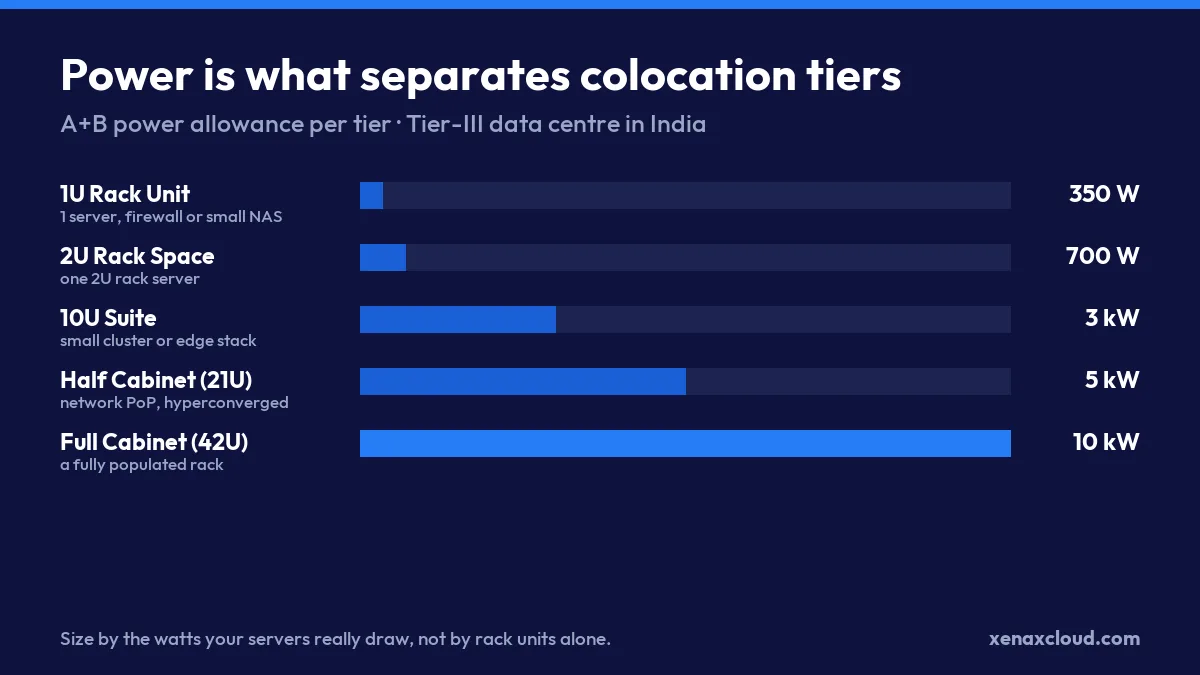
Power is the real meter
Power allowance is the single biggest cost in colocation, because the facility has to supply and cool every watt you are allowed to draw. A cabinet sold with 3 kW costs far less to run than the same cabinet with 10 kW. When two quotes show the same rack size, compare the kW figure first: a cheaper rack with half the power is not cheaper, it is smaller.
A+B power or a single feed
A+B power means two independent power paths reach your rack, so a failure on one side does not take your servers down. Some colocation offers price a single feed and look cheaper for that reason alone. Every Xenax Cloud tier is A+B.
Committed bandwidth or burst
A “1 Gbps port” can mean a 1 Gbps physical port with a much smaller committed rate that is billed hard once you go over it. Ask what rate is committed and what happens above it before you compare two quotes.
Remote hands hours
Remote hands is the data centre engineer who touches your hardware when you cannot be there. Included hours decide whether a failed drive at 2 a.m. is a phone call or a trip: Xenax Cloud includes 2 hours a month at 1U and unlimited hours on a full cabinet.
How Much Power Does a Full Rack Need?
A full rack of modern 1U and 2U servers usually needs between 6 kW and 10 kW, which is why the 42U tier is provisioned at 10 kW.
A typical dual-socket 1U server draws about 250 to 400 W under real load, and a 2U storage or compute node draws 400 to 700 W. Measure what your servers actually draw before you choose a tier; the nameplate figure on the power supply is the maximum, not the normal draw.
Worked sizing rule
Total draw (W) = sum of measured draw of every server + switches + firewalls
Add 20% headroom for peaks and growth
Choose the smallest tier whose power allowance is above that number
Worked Example: A Pune SaaS Company Moving Out of Its Office Server Room
Picture a Pune SaaS company running 14 of its own servers in an office server room: ten 1U application servers drawing about 300 W each, two 2U database servers at 600 W each, and two switches at 150 W each.
Their measured total is 3,000 W + 1,200 W + 300 W = 4,500 W. With 20% headroom that becomes 5,400 W. The servers fill 10U + 4U + 2U = 16U of space.
- The 10U Suite is too small on both counts: 10U of space and 3 kW of power.
- The Half Cabinet fits the 16U, but its 5 kW allowance is below the 5.4 kW they need with headroom.
- The Full Cabinet gives 42U and 10 kW, room for the next two years of growth, and unlimited remote hands for a team that will no longer be on site.
The full cabinet is the right choice here, and the reason is power, not space. That is the pattern behind most full rack colocation pricing decisions. If the same company measured 4 kW instead, the half cabinet would be enough and noticeably cheaper.
Colocation vs Dedicated Server vs VPS: Which One to Choose?
Choose colocation when you already own servers, a dedicated server when you want bare metal without buying hardware, and a VPS when your load changes often.
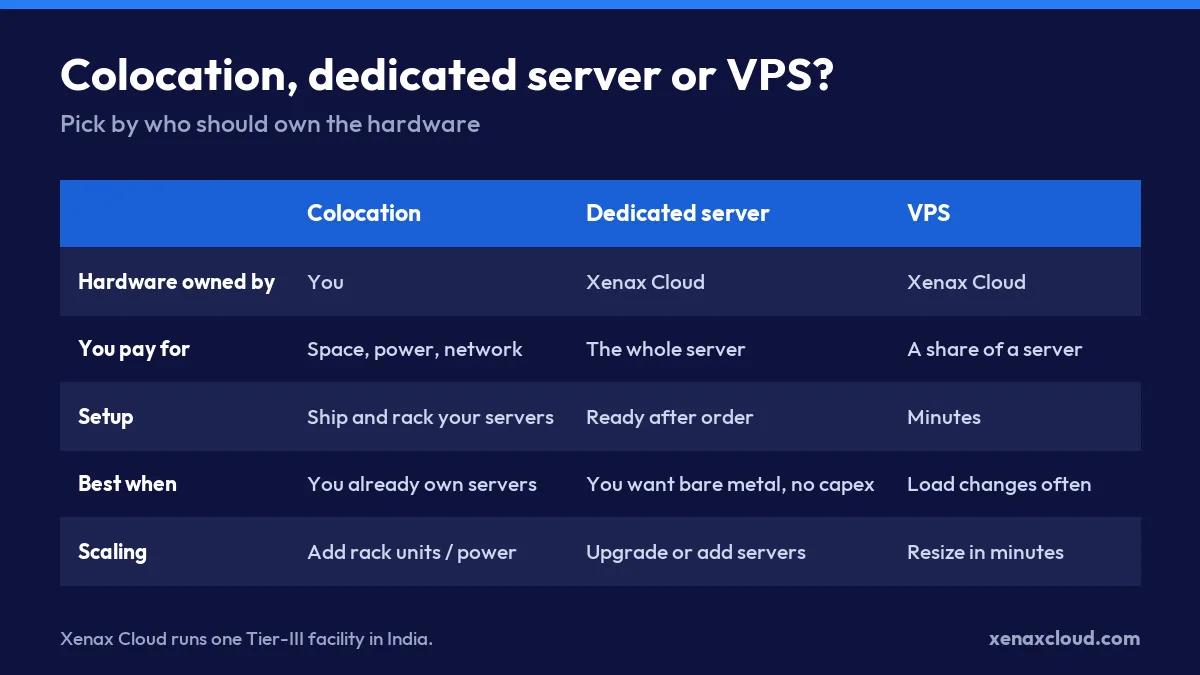
- Choose colocation if you own servers less than four years old and expect to run them for at least another two years. You pay for space, power and a network instead of somebody else’s depreciation.
- Choose a dedicated server if you want physical hardware but not the capital cost, the spares or the hardware failures. Xenax Cloud dedicated servers come with a 1 Gbps port and IPMI access.
- Choose a VPS if your workload grows and shrinks week to week. A KVM VPS resizes in minutes; a rack does not.
Colocation is the wrong choice if nobody on your team wants to manage hardware. In that case, renting is cheaper once you count the engineer time.
How to Move Your Servers Into Colocation
Moving into colocation takes about a week of planning and one day of physical work.
- Measure the real power draw of every server for at least a week.
- Pick the tier from the sizing rule above, with 20% headroom.
- Book the space and get your rack position, IP ranges and access list.
- Label every server, cable and power cord before you unplug anything.
- Take a full backup and test that it restores.
- Ship or carry the servers in on the agreed date and rack them.
- Bring services up one by one and check them from outside the network.
Read more about colocation for startups in India and dedicated server price in India before you decide.
What to Check Before You Sign a Colocation Contract
A good colocation contract states power, bandwidth and support in exact numbers, not adjectives, and full rack colocation pricing is only comparable when those numbers match.
| What to check | Why it matters |
|---|---|
| kW allowance per rack | Decides how many servers you can really run |
| A+B power or single feed | A single feed is one failure away from downtime |
| Committed bandwidth rate | “1 Gbps” may only be the port speed |
| Remote hands hours and hourly rate | Decides how fast a hardware fault gets fixed |
| Cross-connect charges | Some facilities bill every one |
| SLA and what it pays out | An SLA without credits is only a promise |
The Uptime Institute’s tier standard explains what Tier III means for redundancy, which is the level the Xenax Cloud facility is built to.
Full Rack Colocation Pricing: FAQs
How much does a full rack colocation cost per month in India?
A full 42U cabinet at Xenax Cloud is listed in the price table at the top of this page, with 10 kW of A+B power, a 1 Gbps uplink, unlimited cross-connects and unlimited remote hands. The price is monthly, billed in rupees, and updated in one place whenever it changes.
What is the cheapest colocation option?
The cheapest option is a single 1U rack unit with 350 W of A+B power, 100 Mbps of bandwidth and two hours of remote hands a month. It suits one server, a firewall or a small NAS. Anything that draws more than about 300 W should start at the 2U tier.
Is power included in the colocation price?
Yes, power is included up to the allowance of your tier: 350 W on 1U, 700 W on 2U, 3 kW on the 10U suite, 5 kW on a half cabinet and 10 kW on a full cabinet. Size your tier by measured power draw, not by rack units alone.
Can I bring my own servers?
Yes, that is what colocation is. You supply and own the servers; Xenax Cloud supplies the rack space, dual power, cooling, the network and the remote hands to work on your hardware when you cannot be there.
Is colocation cheaper than renting a dedicated server?
Colocation is cheaper over two or more years when you already own the servers, because you stop paying for hardware twice. If you would have to buy new servers first, renting a dedicated server is usually cheaper and removes hardware failures from your list.
Where is the Xenax Cloud colocation facility?
Xenax Cloud colocates in its own Tier-III data centre in India. That is the shortest network path for users in India and nearby regions. For an audience mainly in North America or Europe, hosting closer to them will usually perform better.
If you already own your servers and they draw more than 5 kW together, the full cabinet is the tier to book; below that, the half cabinet usually fits. Measure first, add 20% headroom, and the price table above tells you the rest.