Domain age alone does not determine Google rankings. The answer to “does domain age matter for SEO” is that an older domain has no automatic ranking advantage simply because it was registered earlier. Search performance depends on factors such as helpful content, relevance, links, technical accessibility, and how well a page satisfies the searcher’s needs.
For an Indian business choosing a domain for a new website, this means you do not need to buy an old domain just to compete in search results. A suitable new domain can be a sensible starting point if it has a relevant name, a clean history, and a website built around useful content.
An older domain can still be valuable when it has relevant backlinks, established pages, and a trustworthy history. The important task is to distinguish those existing assets from the domain’s age itself.
Does Domain Age Matter for SEO Rankings?
Domain age by itself is not a direct Google ranking advantage, but the history associated with an older domain can affect its current search performance.
A domain is the human-readable address people use to reach a website. Domain age usually refers to the time elapsed since the domain was first registered, although registration records, ownership changes, and periods of expiry can complicate that history.
Google’s search systems evaluate individual pages using many signals. An older registration date does not automatically make a page more relevant, useful, authoritative, or deserving of a higher position.
For example, a new domain publishing a detailed, accurate answer to a specific search query may serve the user better than an older domain with outdated pages. The older website’s history does not compensate for content that fails to answer the question.
It helps to separate three concepts:
- Registration age: How long ago the domain was registered.
- Website history: What the domain hosted, how the site changed, and whether it has a consistent subject.
- Established search signals: Relevant backlinks, useful indexed pages, and other signals associated with the website and its content.
These are different things. A domain can be old but have little useful history, while a relatively new domain can publish strong content and earn relevant links.
Google explains its search systems and ranking process in its official guide to how Google Search works. Use that documentation as the reference point rather than claims that an older registration date guarantees better rankings.
Domain Age SEO: What Actually Helps a Website Rank?
Domain age SEO is the practice of understanding whether a domain’s history contributes to search performance; the useful distinction is between the date of registration and the assets a website has earned over time.
A domain’s age is easy to check, but the quality of its existing search signals requires more investigation. When comparing websites, examine the factors below instead of treating registration date as a ranking score.
| Factor | What to examine | Why it matters |
| Content quality | Accuracy, usefulness, completeness, and relevance | Helps satisfy the searcher’s actual need |
| Backlink profile | Relevant, editorially earned links and their source pages | Can indicate that other sites find the content useful |
| Indexing | Whether important pages are eligible to appear in Google | Search engines must be able to discover and process pages |
| Technical health | Crawl access, redirects, canonical URLs, and status codes | Prevents avoidable discovery and indexing problems |
| Topical consistency | Whether existing pages relate to the intended subject | Helps preserve useful context and audience relevance |
| Domain history | Past content, ownership changes, spam, and expiry | Can reveal risks that registration age cannot show |
No single item guarantees rankings. A domain with a strong backlink profile can still struggle if its new website targets unrelated topics or publishes weak pages. Likewise, a clean technical setup cannot replace content that does not answer the searcher’s question.
For a new Indian business website, begin by choosing a relevant domain and planning the pages customers need. Build a useful service or product page, publish supporting information, and make sure search engines can crawl the site.
Old Domain vs New Domain: Which Should You Choose?
An old domain is worth considering when its history contains relevant assets you can verify; a new domain is often simpler when you want a clean, clearly branded start.
The right choice depends on the domain’s history, your budget, the brand you want to build, and the time you can spend checking the existing website. An old domain is not automatically better, and a new domain is not automatically disadvantaged.
| Decision factor | Old domain | New domain |
| Search history | May have existing indexed pages and links | Starts without an established website history |
| Brand fit | Existing name may not match your business | Can be selected around your brand |
| Risk | May carry spam, irrelevant links, or previous misuse | Less inherited history to investigate |
| Content planning | Existing pages may need review or redirects | Site structure can be planned from scratch |
| Best fit | Relevant history and useful assets are verifiable | A clean, consistent identity is the priority |
When is an old domain a good purchase?
An old domain can be a good purchase when its past subject is relevant to your intended website, its links come from legitimate sources, and its previous use does not conflict with your brand.
For example, a business creating a website about accounting software might investigate an older domain previously used for legitimate accounting resources. The previous content and relevant links could be useful, but only if the history checks out and the existing signals still make sense.
An old domain is a poor choice when its only selling point is its registration date. Avoid paying extra for age without evidence of useful history, relevant backlinks, a suitable name, or another business benefit.
When is a new domain the better option?
A new domain is usually the cleaner option when you are launching a distinct brand, cannot verify the old domain’s past use, or find suspicious backlinks and unrelated historical content.
A new domain also gives you more control over the name and website structure. You can organise pages around your services, use consistent branding, and build relevant content without having to preserve unrelated legacy pages.
Neither option guarantees a ranking outcome. Choose based on evidence and business needs rather than the assumption that older registration dates receive preferential treatment.
How to Check an Older Domain Before Buying It
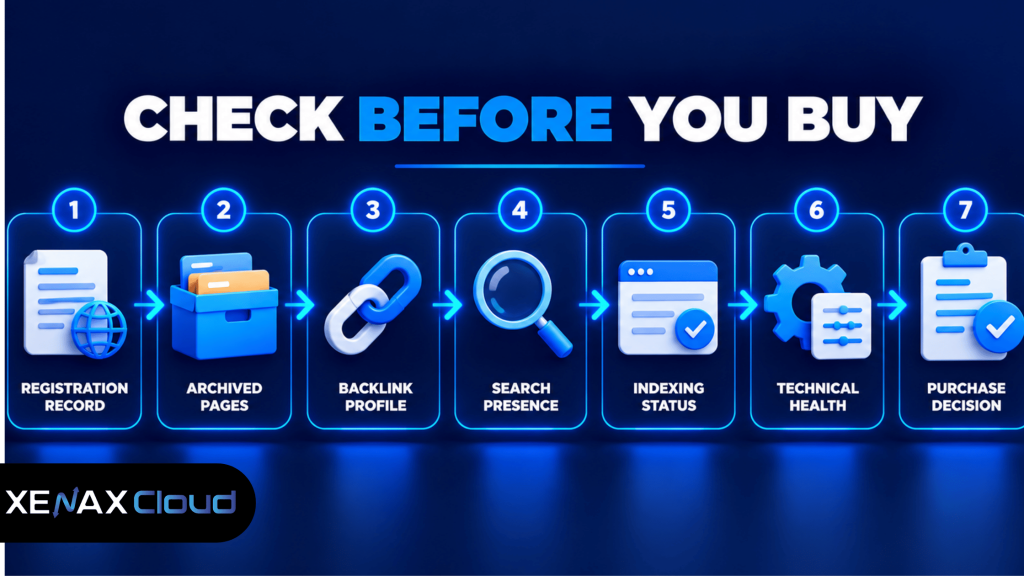
You can assess an older domain by checking its registration history, archived content, backlink profile, search visibility, and technical status before committing to the purchase.
Follow these steps before buying an existing domain:
- Check registration records. Use an ICANN-accredited registrar lookup or RDAP service to inspect available registration details.
- Review past website content. Search the domain in the Internet Archive’s Wayback Machine to see how the site was used over time.
- Inspect backlinks. Use a reputable backlink analysis tool to identify referring websites, anchor text, and suspicious patterns.
- Search for historical references. Search the domain name and its previous brand name to find relevant mentions or signs of misuse.
- Check current search visibility. Search for the domain and important historical URLs, then investigate any unexpected results.
- Review technical status. Check DNS configuration, redirects, HTTPS availability, and whether important URLs return the expected status codes.
- Compare the purchase with a new registration. Consider the name, renewal terms, relevance, and verified assets rather than age alone.
A site:example.com search can help you discover pages Google appears to have indexed, but it is not a complete index report. Use Google Search Console for a site you control to review indexing information more directly.
The Internet Archive can reveal earlier page content, but archived snapshots are not proof that every page existed or that a domain has a clean history. Combine sources before making a purchase.
If you discover spam or suspicious historical use, do not assume that buying the domain will erase the problem. Investigate the evidence, consider the business risk, and choose another domain if the history cannot be explained confidently.
A domain’s historical content matters because relevance can change after ownership changes. If a domain previously covered one topic and now hosts an unrelated business, do not assume that old links or search visibility will transfer cleanly to the new site.
How to Choose a Domain for a New Website
Choose a domain that fits your brand, is easy to remember, uses a suitable extension, and can support your business as it grows.
A domain name is the address customers type or follow to reach your website. A suitable name helps people recognise your business and find the right site, but the name itself does not guarantee high rankings.
Use this practical decision rule:
- Choose a new domain if you are launching a new brand and do not need another site’s history.
- Consider an old domain if its previous topic is relevant and its backlinks and history are verifiable.
- Reject a domain if you find unexplained spam, a confusing brand history, or a name that could mislead customers.
- Prioritise clarity if two domains are otherwise similar; a simple name is generally easier to communicate.
- Compare renewal terms before buying, because the initial registration term and later renewal terms may differ.
Think about the extension as part of your brand choice. Common options include .com, .org, .net, .com.in, .xyz, and .online. Select one that suits your intended audience and purpose, and check the actual availability and registration terms before deciding.
Avoid registering several confusingly similar names solely to try to improve SEO. Multiple domains do not automatically create more authority. If you operate more than one domain, each should have a clear business purpose and a properly planned content strategy.
For registration options, you can explore domain registration with Xenax Cloud. Compare the renewal price with the first-year price and confirm that the chosen extension and name are available before completing the order.
A Worked Example: Should an Indian Business Buy an Old Domain?
An Indian business should buy an older domain only when its verified history provides a clear benefit over registering a suitable new name.
Consider a Jaipur-based accounting consultancy launching a website for bookkeeping, tax documentation, and business compliance services. The owner finds an older domain advertised as valuable because it has existed for several years.
The owner should compare the domain’s previous content, backlinks, brand relevance, and history against a new domain that matches the consultancy’s name.
If the old domain previously hosted unrelated entertainment pages and has suspicious links, its age is not a sufficient reason to buy it. A new, brand-aligned domain is the more sensible choice because it avoids inheriting an unexplained history.
Now suppose another older domain previously hosted legitimate accounting information, has relevant links from real professional resources, and has no obvious signs of misuse. It may be worth further consideration, provided the owner verifies the history and can legally acquire the name.
The decision rule is straightforward: choose the old domain only when the verified assets and brand fit justify the extra work and risk. Otherwise, register a new domain and invest in relevant service pages, helpful articles, internal links, and technical accessibility.
What Should You Do After Registering Your Domain?
After registering a domain, connect it to your hosting, configure HTTPS, publish useful pages, and monitor whether search engines can discover them.
Domain registration and web hosting perform different jobs. A domain gives visitors an address, while hosting stores and serves the website’s files and application. A domain can be registered before the website is ready, but it does not produce search visibility on its own.
Use this launch checklist:
- Configure the domain’s DNS records to point to the correct hosting service.
- Enable HTTPS so connections to the website are encrypted.
- Publish essential pages, including your main service or product page, contact details, and privacy information where appropriate.
- Create clear internal links so visitors and search crawlers can discover related pages.
- Generate and submit an XML sitemap through Google Search Console when appropriate.
- Review indexing reports and fix accidental blocks, incorrect canonical URLs, and broken pages.
- Publish content that directly answers the questions your intended customers search for.
For a website migration, map old URLs to the most relevant new destinations and use appropriate redirects. Keep a copy of the original site and its configuration before changing DNS or redirect rules. This provides a recovery path if important pages stop working.
If the domain has never hosted a website, concentrate on launching a technically accessible, useful site. If it has a previous history, review old URLs and links before deciding what to retain, redirect, or remove.
Xenax Cloud Domain Registration vs the usual alternatives
| Feature | Xenax Cloud | Typical Indian shared host | Global budget host |
|---|---|---|---|
| Starting price | ₹399/yr | ₹199/mo | ₹149/mo (renews ₹499) |
| Storage | .com ₹999/yr | 10 GB SSD | 25 GB SSD |
| DDoS protection | 100 Gbps, always on | Basic | Cloudflare only |
| Support | 24×7, in-house engineers | Tickets, business hours | Chat, outsourced |
| Data centre | India (NVMe) | India | Singapore / US |
| Control panel | cPanel / WHM included | cPanel | Custom panel |
Entry-level plans, list prices including GST where shown. Check each provider before buying — prices change.
See Domain Registration plansDoes Domain Age Matter for SEO: FAQs
Does Google give older domains higher rankings?
No, Google does not award higher rankings simply because a domain was registered earlier. An older website may have useful content, relevant backlinks, and established visibility, but those are separate from the registration date. Evaluate the quality and relevance of those assets rather than using age as a shortcut for authority.
How old should a domain be for SEO?
There is no required domain age for SEO. A new domain can become eligible to rank when its pages are discoverable, indexable, and relevant to searchers. Focus on technical accessibility, helpful content, and a clear site structure instead of waiting for the domain to reach a particular age.
Does domain registration length affect SEO?
Registering a domain for a longer period is not a reliable SEO strategy. Choose a registration term that fits your business plans and budget. Search performance depends on much more than the length of a registration, so do not extend a term solely because you expect it to improve rankings.
Can a new domain rank on Google?
Yes, a new domain can rank on Google. It needs pages that search engines can access and that satisfy relevant search queries. Competition, content quality, website structure, and other ranking signals affect how well pages perform, so a new registration date does not automatically prevent visibility.
Is buying an expired domain good for SEO?
Buying an expired domain can be useful when its name, previous content, and backlink history are relevant and legitimate. However, expired domains may have spam history, unrelated links, or past misuse. Check archived pages, backlink sources, registration records, and current search results before buying, and avoid relying on age alone.
Should I choose an old domain vs new domain for a business?
Choose an old domain when its relevant history and existing assets are verifiable and useful to your business. Choose a new domain when you need a clean brand identity or cannot confidently assess the old domain’s past. Neither option guarantees rankings, so compare risks, relevance, and long-term branding needs.
Does changing domain ownership reset domain age SEO value?
Changing domain ownership does not mean you should expect the domain’s history to provide a guaranteed SEO benefit or to disappear automatically. Search engines evaluate the current site and its signals. After acquiring a domain, review old URLs, backlinks, and previous content, then build a site that serves a consistent and relevant purpose.
If you are launching a new business website, start with a relevant, memorable domain and build useful pages around your customers’ needs. If you are considering an older domain, verify its content history and backlinks before purchasing it. Choose a domain through Xenax Cloud when the name and extension suit your brand, and compare registration and renewal terms before placing your order.