DPDP compliance becomes mandatory for most Indian businesses on 13 May 2027, when the main duties under the Digital Personal Data Protection Rules, 2025 take effect. For a small business, the parts that touch hosting are security safeguards for personal data, breach reporting, clear consent notices and deleting data you no longer need.
This guide turns those duties into a practical checklist for your website, servers, logs and backups. It is a technical guide, not legal advice; ask your CA or lawyer how the Act applies to your business.
What is the DPDP timeline?
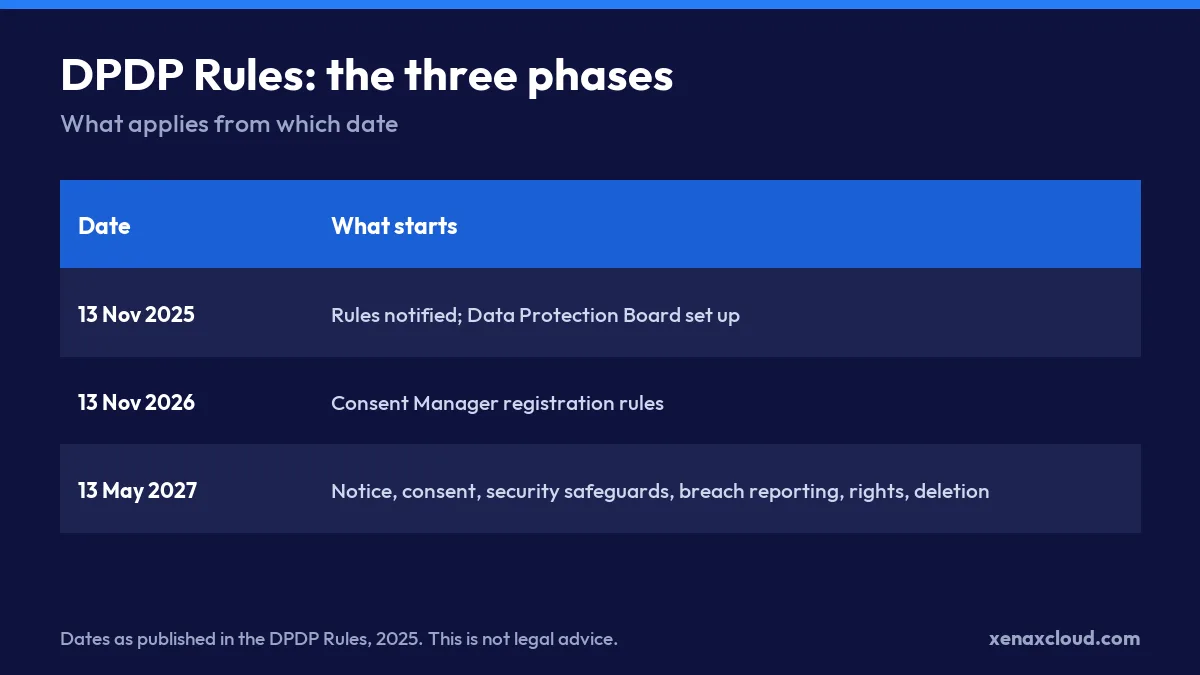
The DPDP Rules were notified on 13 November 2025 and come into force in three phases over 18 months. Procedural rules started at once, Consent Manager rules started on 13 November 2026, and the duties that affect almost every business start on 13 May 2027.
The Act and the Rules are published by the Ministry of Electronics and Information Technology on the MeitY website. Read the final text there rather than summaries, because summaries often disagree on details.
Does DPDP apply to a small business?
Yes, if you collect personal data of people in India in digital form. A clinic booking form, a coaching institute’s student list, a WooCommerce store’s customer accounts and a CA firm’s client files all count. Size does not exempt you; some duties are heavier only for businesses the government names as Significant Data Fiduciaries.
In DPDP language, your business is a Data Fiduciary (it decides why and how data is used), and your hosting provider is usually a Data Processor (it processes data on your behalf). You stay responsible for compliance even when the server is rented.
What do the DPDP Rules expect from your servers?
The Rules ask for reasonable security safeguards. In hosting terms that means controlling who can open personal data, protecting it from being read if stolen, keeping logs to detect misuse, and having backups to recover from loss.
| Safeguard named in the Rules | What it means on a server |
|---|---|
| Encryption, masking or similar | HTTPS on every page, encrypted backups, masked data in test copies |
| Access control | Separate logins, no shared admin password, remove leavers on day one |
| Visibility of access | Logs of logins and admin actions, kept for at least one year |
| Continuity | Backups you have tested, so data survives a disk failure or ransomware |
| Contracts | A written agreement with processors such as your hosting provider |
Our how to secure an RDP server guide covers the login and firewall side for Windows servers.
Do I have to keep data in India?
DPDP itself does not require all personal data to stay in India. The Act allows transfers abroad except to countries the government restricts by notification. Other rules can still apply: payment data rules for payment system operators, and sector rules for banks, insurers and some government work.
Many businesses choose Indian hosting anyway, because it removes the question for customers and auditors, and because Indian visitors get faster pages. Xenax Cloud servers run only in a Tier-III data centre in India.
What happens if there is a data breach?
Under the Rules, you must inform the Data Protection Board and each affected person without delay, and send the Board a detailed report within 72 hours of becoming aware of the breach. That is only possible if you can see what happened, which is why logs matter.
Prepare three things now:
- A named person who decides when an incident is a breach.
- A list of where personal data lives: website database, Tally, CRM, email, backups.
- Contact details for your hosting provider’s support, so you can get logs and snapshots quickly.
Also remember the separate CERT-In directions, which require reporting certain cyber incidents to CERT-In within six hours.
How does DPDP affect your website forms and backups?
Your website is usually where personal data first arrives, so the forms and the database behind them deserve the first look. Every contact, booking, enquiry or checkout form collects names, phone numbers or email addresses, and each one needs a short notice saying what you collect and why.
Three common gaps on small business sites:
- Old enquiry data that is never deleted. A form plugin that has stored every enquiry since 2019 holds years of personal data with no purpose left. Export what you need and delete the rest.
- Backups nobody controls. Full-site backups copied to personal laptops or free cloud drives are personal data too. Keep them encrypted and in places you manage; our guide on how to back up a server shows a simple routine.
- Outdated software. An unpatched CMS, plugin or operating system is the easiest way in. Remember that Windows Server 2016 stops getting security updates in January 2027, as we explain in Windows Server 2016 end of support.
Fixing these three is cheap and removes most of the risk before May 2027. Write down what you changed and when; a dated record of the steps you took is useful evidence if the Board ever asks how you protect personal data.
A DPDP compliance checklist for your hosting
Use this DPDP compliance checklist before May 2027. Each line is a setting or a habit, not new software.
- Inventory: list every place personal data is stored, including old backups and test copies.
- HTTPS everywhere: a valid SSL certificate on every page and form.
- Logins: one account per person, strong passwords, two-factor authentication on admin panels.
- Least access: staff see only the data their job needs.
- Logs: keep server and application login logs for at least a year.
- Backups: encrypted, stored in a second place, restore tested every quarter.
- Deletion: delete data when its purpose ends; set a retention period for leads and old customers.
- Notices: a clear privacy notice and consent text on every form that collects personal data.
- Processor agreement: a written agreement with your hosting and software providers.
DPDP compliance: FAQs
When does DPDP compliance become mandatory?
The main duties apply from 13 May 2027. The Rules were notified on 13 November 2025 with an 18-month window, and Consent Manager rules started on 13 November 2026.
Is my hosting provider responsible for DPDP compliance?
You remain responsible as the Data Fiduciary. Your provider is a processor and should follow your instructions and keep the servers secure, so put that in a written agreement.
Do I need to move my website to an Indian server?
Not because of DPDP alone. Sector rules may require it for some businesses, and many choose Indian hosting for simpler audits and faster pages.
How long should I keep server logs?
The Rules expect logs to be kept for at least one year for detecting misuse. Keep them protected, because logs can contain personal data too.
What is the penalty for weak security?
The Act allows the Board to impose penalties of up to two hundred and fifty crore rupees for failing to take reasonable security safeguards. Actual penalties depend on the case.
If your website, Tally or CRM holds customer data, start with the inventory and logging steps this month, and host the systems on a Xenax Cloud VPS or Windows server in India where you control logins, logs and backups yourself.