An .io domain is a domain name that uses the .io top-level extension, originally assigned to the British Indian Ocean Territory. Technology companies, software developers and startups often choose it because the letters are associated with input/output in computing, giving the address a technical identity.
For an Indian startup, the decision is not just about whether the name looks modern. You should consider brand recognition, customer expectations, search visibility, registration rules and the renewal terms before choosing the extension.
The .io extension can work well for a software product or developer-focused business, but it is not automatically better than .com. The right choice depends on the audience you want to reach and how you plan to use the domain.
What Is an .io Domain?
An .io domain is a country-code top-level domain (ccTLD) that identifies a registered internet name ending in .io. Although it was assigned to the British Indian Ocean Territory, it is widely used by technology businesses as a brand-oriented extension.
A top-level domain (TLD) is the final part of a domain name, appearing after the last dot. In example.io, the TLD is .io, while example is the second-level name selected by the registrant.
The letters IO also have a familiar technical meaning: input/output. Input/output describes how a computer system receives data and produces results. This association has made .io recognisable among software companies, developer tools, application platforms and technology communities.
However, .io is not a technology-only extension. Its use does not require the registrant to operate a software company, and registering one does not certify that a business is technical or legitimate.
The distinction between its official classification and common commercial use matters. A domain extension can have a country-code origin while being used internationally by organisations that have no connection with that territory.
How Does an .io Domain Work?
An .io domain works through the Domain Name System (DNS), which connects a human-readable domain name to the internet services that handle website or email requests.
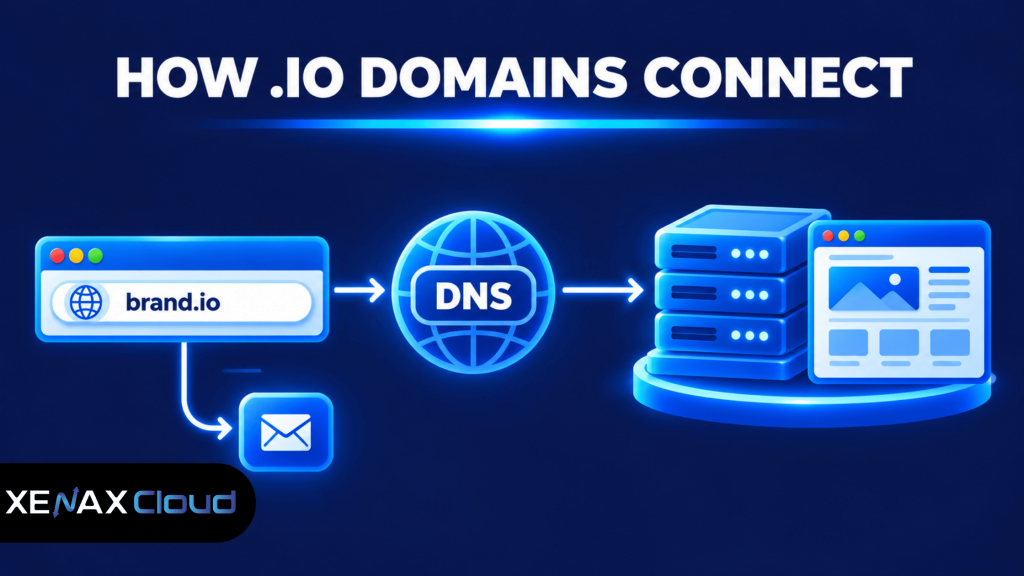
When someone enters brand.io in a browser, the DNS lookup helps the browser find the destination configured for that hostname. The domain can point to a website hosted on shared hosting, a VPS, a dedicated server or an external website platform.
An A record can point a hostname to an IPv4 address, while an AAAA record can point it to an IPv6 address. A CNAME record can make one hostname an alias of another hostname, subject to DNS rules and the provider’s configuration.
Domain registration and website hosting are separate services. Registering brand.io gives you control over the domain for its registration period, but you still need a hosting service or another destination if you want it to display a website.
You can also configure DNS records for services other than a website. For example, MX records identify the mail servers responsible for receiving email for the domain, while TXT records are commonly used for verification and email authentication.
Why Is an .io Domain Popular With Technology Startups?
An .io domain for startups can provide a short, technology-associated brand address that fits software products, developer platforms and technical services.
The extension has become familiar in technology circles because IO is commonly understood as input/output. A startup building APIs, cloud tools, developer software, data platforms or infrastructure products may find that association relevant to its brand.
Consider these examples of how a startup might use the extension:
- Developer platform: buildtool.io for a software development product.
- SaaS application: projectdesk.io for a subscription-based business application.
- API service: connectapi.io for a developer-facing integration platform.
- Technology publication: stacknotes.io for technical articles and tutorials.
- Data product: insightdata.io for an analytics application.
These are illustrative naming examples, not claims that the domains are available. Check the exact name through a registrar before using it in a business plan or marketing campaign.
An .io domain can also be useful when the preferred brand name is unavailable under another extension. But do not add confusing words, extra hyphens or unusual spellings just to retain a particular name.
The name should remain easy to pronounce, type and share verbally. If a customer hears your domain during a phone call, they should be able to understand how to spell it without repeated explanation.
.io Domain for Startups: Is It Better Than .com?
An .io domain for startups can be a suitable branding choice for a technology product, but .com may be more familiar to a wider audience. Neither extension automatically makes a website more credible or successful.
| Decision factor | .io domain | .com domain |
| Common association | Technology and developer products | General commercial and business use |
| Audience familiarity | Familiar in many technology communities | Widely recognised across industries |
| Brand positioning | Can suit a technical product identity | Can suit a broad company identity |
| Search geotargeting | Google treats it as a generic country-code domain | Generic top-level domain |
| Naming choice | Useful when the desired name is available | Often considered for a primary brand address |
A common misconception is that .io automatically gives a startup better search rankings because it is associated with technology. Google does not grant a ranking advantage simply because a company uses this extension.
There is also a technical distinction worth understanding. The .io extension is classified as a country-code top-level domain, but Google includes .io among country-code extensions it treats as generic for geotargeting. This means a website using .io is not automatically treated as targeting the British Indian Ocean Territory.
Google explains this distinction in its documentation on managing multi-regional and multilingual websites. Search performance still depends on the content, technical accessibility, relevance, links and usefulness of the website.
For an Indian business serving Indian customers, an .io domain does not by itself communicate that the company is based in India. Make your business location and service area clear through website content, contact information and relevant local signals.
When Should You Buy an .io Domain?
You should buy an .io domain when its technology-oriented identity fits your brand, the exact name is available and the registration terms suit your long-term plans.
Before registering, check these points:
- Brand fit: Does the extension match the product, service and audience?
- Spelling: Can customers remember and type the full domain correctly?
- Name conflicts: Does the name create confusion with an existing company or trademark?
- Availability: Is the exact domain available for registration?
- Renewal terms: Have you compared renewal terms with the first registration term?
- Account ownership: Will the domain be registered under the correct person or business?
- DNS control: Can you manage the records needed for your website and email?
A domain search result does not reserve a name. Another person may register an available domain before you complete the purchase, so confirm the final result and complete registration when you are ready.
For a practical process to check names and extensions before registration, read How to Check Domain Availability Before You Register. It explains why you should verify the exact spelling and review alternatives before committing to a domain.
Xenax Cloud lists .io among its domain registration extensions. You can check the available options through Xenax Cloud domain registration, then review the registration and renewal terms shown for the selected name.
Worked Example: An Indian SaaS Startup Choosing a Domain
Consider a five-person SaaS startup in Pune building a project management application for software teams. The founders want a short brand address for product documentation, account access and marketing pages, and they have shortlisted taskpilot.io.
The .io extension fits the product’s technology audience, but the founders should not assume that the name is available or that using it will improve search rankings. They should first check the exact registration status, possible brand conflicts and whether customers can spell the name easily.
If taskpilot.io is available and the founders are satisfied with the brand checks and renewal terms, registering it is a reasonable decision. If it is unavailable, they should compare a clear alternative brand name or another suitable extension rather than creating a confusing variation.
The company should register the domain under the appropriate founder or business-controlled account, keep its contact details accurate and enable account security features offered by the registrar. It should also record the renewal date and retain access to the account recovery email.
For this requirement, the domain registration product is the relevant Xenax Cloud service. The founders do not need to select a larger hosting configuration just to register the domain; website hosting can be selected separately according to the application’s technical requirements.
How to Register an .io Domain
You can register an .io domain by checking the exact name through a registrar, reviewing its terms and completing the registration under the correct owner.
- Choose the name. Select a short brand name that is easy to spell and pronounce.
- Check availability. Search the exact name with the .io extension.
- Review alternatives. Compare sensible variations if your preferred name is unavailable.
- Check brand conflicts. Search for similar business names and relevant trademarks.
- Compare renewal terms. Review the renewal conditions alongside the first registration term.
- Enter registrant details. Use accurate contact information for the person or business that should control the domain.
- Complete registration. Submit the order and confirm that the domain appears in your account.
- Configure DNS. Connect the domain to your website, email or other services.
After registration, verify that the domain appears in the correct account and that the registrant contact email is accessible. Keep the account credentials and recovery details in a secure place, because losing access to the registrar account can complicate domain management.
If you are connecting the domain to a website, obtain the correct nameservers or DNS records from your hosting provider. Do not change existing MX records without checking your email provider’s configuration, because incorrect mail records can interrupt incoming email.
What Should You Check Before Renewing an .io Domain?
Before renewing an .io domain, check the renewal terms, expiry date, account ownership and payment method so the domain does not lapse unexpectedly.
Domain registration is time-limited. If you do not renew it according to the registry and registrar rules, the domain can expire and may eventually become available for someone else to register.
Keep these safeguards in place:
- Enable renewal reminders or auto-renew where appropriate.
- Keep the registrant email address current and accessible.
- Check that the payment method used for renewal is valid.
- Review the renewal terms rather than relying only on the initial registration offer.
- Keep control of the registrar account with the business owner or an authorised administrator.
- Confirm transfer and domain-lock settings before making registrar changes.
Do not assume that an expired domain will remain reserved for you. The recovery process and deadlines depend on the applicable registrar and registry rules, so check the current terms before the expiry date.
A further consideration for .io is its country-code origin and the registry arrangements behind it. Businesses planning to use a domain as a long-term product identity should review current registry notices and registrar policies periodically rather than assuming that every extension has identical administration and renewal rules.
.io Domain: FAQs
Is an .io domain a country-code domain?
Yes, .io is officially classified as a country-code top-level domain associated with the British Indian Ocean Territory. However, it is widely used internationally by technology companies and startups. Google also treats .io as a generic country-code domain for search geotargeting purposes.
Is an .io domain good for an Indian startup?
Yes, an .io domain can suit an Indian startup building software, cloud products, developer tools or technology services. It gives the brand a technical association, but it does not prove the company is based in India. Make your business location and contact details clear on the website.
Does an .io domain improve Google rankings?
No, using an .io domain does not automatically improve Google rankings. Google treats .io as generic for geotargeting, but rankings depend on content relevance, technical accessibility, website quality and other search signals. Choose the extension for branding and audience fit rather than an assumed ranking advantage.
Can anyone register an .io domain?
Generally, applicants from different countries can register second-level .io domains, subject to the registry’s rules and registrar requirements. The registry may apply naming and registration conditions, so check the current rules before submitting an application. Keep the registrant details accurate after registration.
Should I choose .io or .com for my startup?
Choose .io if its technology association fits your product and your target audience recognises the extension. Choose .com if broad familiarity is more important to your brand. Check availability, spelling, renewal terms and possible brand conflicts before making the final decision.
Can I use an .io domain for business email?
Yes, an .io domain can be used for business email when you configure the required DNS records with an email provider. You generally need the correct MX records and may also need SPF, DKIM and DMARC records to support email authentication and delivery.
Does buying an .io domain include website hosting?
No, domain registration and website hosting are separate services. Registering an .io domain reserves the name for its registration period, while hosting stores and serves your website or application. You can connect the domain to Xenax Cloud hosting or another supported hosting provider through DNS.
If your product is aimed at software developers or technology customers, shortlist a clear .io brand name, check its availability and review its renewal terms. Register it under your business-controlled account, then connect it to the hosting and email services your startup actually needs.